Tag Archives: Meetings

Do brainstorming sessions really achieve anything?

6a00e54ee2334e8834013485dfaefd970cThere are plenty of people who are fans of brainstorming sessions, but I have to say I’m not one of them. Further to this, I suspect most people in the creative department don’t  like them.

Why? Well, I reckon it’s a bit like putting a comedian on the spot by asking him to ‘say something funny’. Sure, he might manage to get a smile, but it will hardly be his greatest work.

In my experience, the ones who most like brainstorm sessions are those who don’t have to do ‘the heavy lifting’, so to speak. Their theory is you get a whole heap of people in a room and bash out some stuff on a given topic or task. You usually end up with a variety of stuff scribbled on sheets of paper.
Then most people walk away from the job, and some poor bastard has the task of converting those pieces of paper into a working solution.
It’s important to note here that this is a generalisation – some brainstorm sessions do provide fruitful solutions and ideas, however many merely give the appearance that work has been done.
The real problem is that all too often, the person who called the meeting treats the end of that meeting with a ‘Job done. Tick’ mentality rather than a ‘Okay, this is an interesting starting point. Now the real work begins by exploring if any of these ideas have legs’.

Great creative work is very rarely ‘bashed out’ by a group of people. Sure, two heads are often better than one, but too many chefs and too little time just makes a mess.
The brainstorm workshop never allows for any depth of thinking. It’s like the fast-food equivalent of idea generation – it might suffice momentarily, but it’s not really a healthy way of living.
What’s your opinion of brainstorm sessions?

DUSTIN LANE
Brand Strategy | Advertising Concepts | Copywriting

Visit risinggiants.co or dustinlanecreative.com

Where does the power lie? And where will it lie in the future?

A couple of weeks ago I was introduced to this online video (below).

It’s funny because at some stage we’ve all sat in a meeting like that – where things don’t quite make sense but people insist on pushing ahead regardless. (Note to anyone who has worked with me before: you’d probably know this as the time I ask something like, ‘Are we confusing momentum with progress?’ or ‘Are you sure we’re not trying to build a house on sand?’)

Anyway, I think this video is a great representation of where the power lies in most business transactions. But more importantly, it can also make you wonder how things will work in the future.
So let’s just look at that.

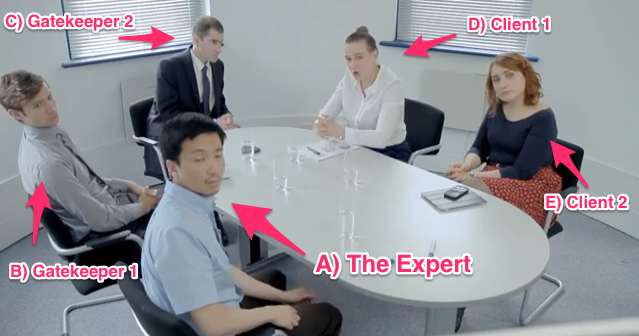
Meeting LabelsThere are 5 people in the meeting and for the sake of this article, I’ve labelled each of them.
The actual transaction is happening between Person A and Person D.
Person A is supplying the product/service that Person D is seeking.
However, Person C owns that relationship and has positioned A as his commodity.
E is a minor stakeholder in D’s purchase.
B is simply training to be like C in the future.

This is how business has tended to work throughout the industrial age.
In most cases, the power has always rested with ‘the gate’ rather than the expert.
For example, Apple doesn’t make music but by owning the means in which people access it, they take the biggest cut.
Likewise for Google. They don’t make the information, but they facilitate access to it.
Supermarkets don’t grow food, but they control the gate by which people obtain it.

However the dynamics of this model are being challenged and this can offer up a number of scenarios for how the advertising business (and many others) will operate in the future.
It’s now easier than ever for Person D to directly contact Person A. This doesn’t paint a pretty picture for Person C (or B) as it cuts them out of the loop.
However, new opportunities exist for people to invent themselves as a ‘Person C of the future’ (like the creators of Airbnb being a gate to accommodation, or LinkedIn being a gate to labour).

Whichever way it plays out, one thing is for sure – there are too many people at that table.
Only one person is doing the work.
Two people are making the arrangements.
One person is the major buyer.
One person is a minor buyer.
In a world that is always looking for greater efficiency, where do you think the axe will fall?

DUSTIN LANE
Brand Strategy | Advertising Concepts | Copywriting

Visit risinggiants.co or dustinlanecreative.com