Tag Archives: marketing

In advertising, perception is everything.

Each morning, I have a coffee and look at the beach. There’s usually a lot of pondering involved. Sometimes, it’s deep pondering on the workings of the universe, and other times it’s more superficial, like ‘why isn’t the letter ‘w’ called ‘double v’ rather than ‘double u’? Or, wondering if Volvo drivers are secretly happy now that the world has Tesla drivers.

Anyway, this pondering changed direction when I saw a person walk past with their phone perched in a gimbal while they did a ‘walk and talk’ video. This prompted me to think about where advertising is at the moment, and where it’s headed.

In simple terms, you could say that advertising’s job IS perception. After all, it creates, manipulates, and manages how a product is perceived.

But what about the ad industry itself – how is it perceived?

Apparently, size does matter.

It seems advertising used to be a bigger deal.
Big, mass media.
Big ideas.
Big productions.
Big budgets.
Big salaries.

Everyone knew it, from banks to breweries.

But then, things got smaller.
Media splintered, and catered to smaller audiences.
Screens got smaller.
Timelines got smaller.
And budgets and salaries followed.

Perception plays a role here.

If the screen is smaller, and the audience is a single person rather than multiple people gathered to view a single screen, it’s no longer perceived as ‘big’. The grandeur is gone.

In the ad industry, when the internet first started making inroads, we all became familiar with a client’s production budget shrinking to reflect the media in which the ad would be shown. Many clients expected the production of a 30-second film to be much cheaper if it was ‘only going online’.

Can you imagine what a car dealer would tell you if you went into a showroom and wanted to buy a car for a cheaper price and offered the rationale that you’d only be driving it on particular roads?

When cost-cutting kills more than your costs.

Most people would be familiar with the old triangle of values: ‘Quality, Time, Cost – have any two’. It’s based on the premise of two values coming at the detriment of the third (i.e. you can have the work done well and quickly, but it won’t be cheap OR you can have the work done well and cheaper, but it’ll take time OR you can have the work done cheaply and quickly, but it won’t be good).
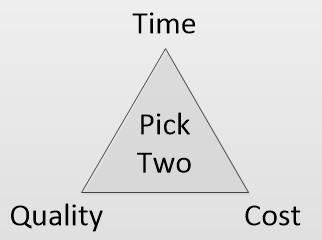
(I was always of the opinion that quality wasn’t expendable, so one of the other two values had to be sacrificed. Not all marketers agree.)

Then, along came generative A.I.
And, with it, the promise that you can have all three values.

Now, whether it currently delivers on quality is up for debate. Problems with image continuity, anatomy, and receiving what you actually requested is still an issue. But we all know the tech will eventually get there.

So, what then?

Well, that’s when perception might really come into play.
Right now, it’s being over-looked, either unconsciously or otherwise.

Perception doesn’t appear on a spreadsheet.

When people know that something has taken effort, they assign a higher value to it.
It’s why people get their photo taken in front of the Sydney Opera House.
It’s why people appreciate a beautifully prepared meal.
And, it’s why brands put the words ‘hand-made’ on labels.

However, when we get to that stage where people will know, or assume, that someone has simply punched in a few prompts to create something, that same value is unlikely to be assigned.

Instead, the output becomes highly disposable.

The inference by the viewer/reader/listener is ‘that business has not bothered to invest in their message, so why should I invest my time in it?’

Of course, consumer psychology like this doesn’t show up on a marketing spreadsheet, but it’s something that needs to be considered.

After all, once everyone has seen behind the curtain and knows how the magician does his tricks, the magic itself disappears.

DUSTIN LANE
Brand Strategy | Creative Concepts | Copywriting

Visit risinggiants.co or dustinlanecreative.com

7 ways you’re sabotaging your own advertising.

Advertising-solutions

When you’ve worked on enough projects, you see some reoccurring themes. And, some of those themes are ways organisations seemingly work hard to ensure that their own advertising does not succeed.

Of course, they don’t do it on purpose, but it’s more common than most people like to admit. Here’s a quick list. See if any apply to your organisation.

1. Perspective is everything.
There’s a saying in legal circles that goes ‘Any lawyer who represents himself has a fool for a client’. The simple reason why, is because they’re too close – they lack the perspective to see things from the outside, often due to their own unconscious bias limiting their view.

Smart people understand that and take measures accordingly. Others let their ego get in the way.

Many times, the things you might think are important, are not of any significance to your target audience.

2. You’re not truly customer-focused.
This usually comes down to different agendas and barriers people create for themselves. And, put simply, people need to be honest with themselves about it.

Is that latest campaign really for the customer, or is it simply to make senior management or shareholders feel good about themselves?

Is that work made in a way that will truly resonate with the target audience, or are you simply trying to schmooze an advertising awards jury?

Are you using assets and imagery that will actually work, or merely ones that compliance and legals have already approved?

3. Too much complexity.
Bureaucracy loves complexity because it gives the illusion that lots is happening. But Da Vinci said it best when he said ‘Simplicity is the ultimate sophistication’ (although he probably said it in Italian or Latin).

See, the number one rule is to make it easy for your customers. And if you haven’t done that, usually by distilling your messaging or your offering, you need to do more work.

Your customers aren’t going to do it. Unless they’re a good way down the sales funnel (excuse the jargon – I hate it too), people simply don’t care. They have school drop-offs to do, work meetings to sit in, dishwashers to unpack, Netflix shows to binge, 10,000 steps to do and eight glasses of water to drink.

In summary, make sure you’re not loading up the camel.

4. You’re playing to ‘not lose’.
We need to be clear that ‘winning’ and ‘not losing’ are not the same thing.

While caution and informed decision-making is paramount, if you’re number 1 priority is to ‘not lose’, the simplest way to achieve that is not to play at all. Then, your objective is pretty much guaranteed.

Advertising’s job is to stand out, not fit in.

So, be clear and honest with yourself about what you really want to achieve.

5. Advertising is usually subtle (in both victory and defeat).
If you happen to be sitting on the other side of a two-way mirror, watching a research group who has turned up for fifty bucks and free sandwiches, critique work, you might hear the term, ‘it wouldn’t make me buy it’.

Now, despite what digital advertising platforms might tell you, attribution of an advertisement’s success, and how it influences people, is a far more complex beast.

It’s important to grasp the fact that there are many factors involved. I understand it might not be convenient, or might not align with an organisation’s KPIs, and ROI charts that need to be shown in meetings, but that doesn’t mean it’s not true.

If the author or creator of a communication seems reluctant to make your requested changes, it might be because you’re messing with a part of it that, however subtle, will diminish its impact.

Successful communications can probably be best summarised by Al Pacino’s ‘Inches’ monologue in Any Given Sunday (just swap out winning in a football game to winning in business).

6. You’re spending more time and effort on process than the work itself.
In advertising and business, the result is the most important thing.

However, somewhere along the line, people seem to have lost sight of this and the process is often given more focus. Perhaps it’s a throw-back to high school maths, where you got higher marks for getting the wrong answer if you did it the right way, rather than the right answer by doing it the wrong way. Who knows?

Anyway, I’ve seen many marketers and ad agencies spend more time on the peripheries of delivering the work, rather than the work itself. This can take many forms – ranging from time-sapping, non-productive meetings, to being dictated what tools or platforms to use, to creating a 27-page deck to present a few social posts.

Try and always keep your focus on the true goal, rather than unknowingly creating barriers to it.

7. A tsunami of crap.
Let’s be honest here.The majority of adverting has always been pretty ordinary, and there are a number of reasons on why that’s so. However, we are now entering an era where it will plunge to new depths.

The barriers to entry have never been lower. Anyone with a phone can now make stuff and publish it. Generative AI, plus access to simple editing and design tools has all made it much easier to produce stuff.

However, just because one has access to tools doesn’t make them an architect. The inconvenient truth here is that the biggest workload in delivering effective communications is the thinking part. You can call it strategy, or consumer psychology, or insight-driven ideation, or whatever, but the important thing to note is that it’s not just a case of pressing buttons on a device.

And remember, AI’s frame of reference doesn’t just include the good stuff – it includes all the rubbish that’s out there too.

So, you’ll need to be clear on what your goal truly is here.
Are you simply adding to all the crap, or are you cutting through it?

DUSTIN LANE
Brand Strategy | Creative Concepts | Copywriting

Visit risinggiants.co or dustinlanecreative.com

Seven red flags in advertising.

To an outsider, advertising and bullshit might seem to go hand-in-hand. However, I’ve always tended to take a no bullshit approach. I have little time for hyperbole, jargon, and other crap that gets in the way of the goals we wish to achieve.

This can sometimes make scrolling through LinkedIn feel like floating in a sea of crap, as I encounter AI-written ‘thought leadership’ pieces, critiques of ads from people who’ve never actually made an ad, and people with wonderfully self-indulgent titles like ‘unicorn’ and ‘ninja’.

So, in a bid to combat some of the bullshit, offer some reality, and dispel some myths that have grown like a post-Christmas waistline, I thought I’d jot down a few red flags I regularly come across.  

1.    ‘We need someone to do everything for $50k per year.’

Okay, I get it – your budget is $X, but that doesn’t mean you simply combine all the things you need done into one role and advertise it for your budget. If it were, rather than hiring electricians, carpenters, plumbers, painters, concreters, tilers, and landscapers to build a house, I could just invent a role like ‘Habitational Construction Viscount Unicorn’ and seek someone to build an entire house for $50k.

Firstly, it’s not going to happen. And, secondly, even if it did, would it be a house you’d want to live in?

The simple truth is that if you want something done well, there’s no such thing as a ‘one-person agency’. It’s the same reason your GP doesn’t also dabble in a bit of dentistry and brain surgery. You get what you pay for, no matter how inconvenient that might be for the budget.

2. ‘Isn’t copywriting just the words?’

Look, the ad industry hasn’t done itself any favours with the ‘copywriter’ title. My mum has never even understood what a copywriter does. These days, the plethora of people you can find online proclaiming to be copywriters ranges from people who can use spellcheck on a computer to ex-journos (and anyone in between, who has ever said the alphabet).

The truth is, the ‘writing’ part is actually secondary in the role of a copywriter. The bigger, and more difficult part is the thinking. And by that, I mean both strategic thinking, and conceptual thinking.

‘Hey. Isn’t strategy covered by the planner?’, I hear you say. Well, any copywriter worth their salt is also a strategist. David Ogilvy. Leo Burnett. Mary Wells Lawrence. All great copywriters, yet all inherently great strategy planners. Even the fictional TV character Don Draper is a great strategic thinker.

And, yes, of course there is the writing. What you may not know is that for every word you see in the final output, there are plenty behind it that have fallen. For example, a good copywriter considers the difference inferred by a bank that tells its customers ‘Your withdrawal has been approved’ versus ‘Your withdrawal has been confirmed’.

A million decisions like this happen behind every piece of work you see (if it’s been done well, that is).

3. ‘The strategy and idea is all done. We just need…’

Hear that? It’s alarm bells ringing.

Sure, on first glance it seems innocent enough. After all, the strategy and idea is essentially where all the heavy lifting happens. If that’s done well, the following jobs (copywriting and other ‘executional’ parts of the project) should be simpler. But the important words are “if it’s done well…”. Sometimes it is, sometimes it isn’t.

If it isn’t, it’s like being asked to put a roof on a house, when you know the house won’t be able to take the weight of a roof.  For this reason, I’m always sceptical when the author of an idea doesn’t want to (or can’t) make their own idea actually work.

I’ve always held the position that the best person to make the idea work is the originator, because you make a bed differently if you’re the one who has to sleep in it.

4. ‘The visual assets are done. We just need a brand positioning.’

This one always unleashes a raised eyebrow. That’s because anyone who understands communication would understand that visual assets, typefaces, brand colour palettes, copy style and tone all have to be pulling in the same direction. And the North Star for that direction is the brand positioning.

To try and retro-fit a brand positioning in this way is like trying to lay the foundation slab of a house – after you’ve already built two of the bedrooms and the kitchen.

Any professional communicator understands brand architecture, the process, and that everything about the brand needs to work together.

5. ‘Can’t I just teach myself and do it?’

Well, yes. But we also need to accept that knowledge and talent are not the same thing.

The simple truth is that some people are quite unique in their ability to do a particular task. For example, regardless of how much I study the biomechanics of running, or how many mornings I get up at 4am and train the house down, I will never be able to run faster than Usain Bolt. Sure, my running will likely improve, but I will never be an awesome runner.

It would be the same for an artist. Sure, you can learn that mixing yellow and blue makes green, but you may never have the vision to foresee a human-figure called David lying within a 9-tonne block of marble.

So, while you can improve through education and training, there are some talents you may never master – no matter how many Simon Sinek or Gary V videos you watch.

6. ‘Everyone’s a creative’

When I say ‘creative’, I’m talking about copywriters, art directors, designers, directors, and their ilk.

This ‘everyone’s a creative’ phrase is the ugly, bastard-cousin of ‘ideas can come from anywhere’. Both phrases discount the skills and talents required to do the job correctly. Part of this is due to the current low barriers of entry, largely brought about through technology. Yes, Canva, Apple et al – I’m looking at you.

The truth is, simply having the tools doesn’t mean you know how to use them correctly.

To be clear, I’m not talking about their technical operation. Instead, I’m talking about the underlying skills that dictate which tool to use and when to use it. (eg. What does a close shot mean? Why doesn’t that typeface feel right? Is the colour palette communicating my intention? Should the language be colloquial or more formal? What does that posture imply?)

These are the true skills and talents required to be a professional communicator, rather than simply knowing which button to press.

7. ‘But, can you do social posts?’

In a world of internet memes, I imagine this one sitting up there, with the headline ‘Tell me you don’t know what an advertising creative does, without telling me you don’t know what an advertising creative does.’

Any true copywriter (or art director) has made a career from being a professional communicator. This includes consideration of the medium and context of how and where the message is consumed. Trust me, any creative who has worked in mediums that include TVC, pre-rolls, direct mail, out-of-home, point-of-sale, eDMs, posters, radio, flyers, and almost anything else, can also do social. Yes, social might have its own nuances, but so does every other medium.

In short, it’s a bit like asking a Formula 1 driver if they know how to drive an automatic Toyota Camry.

Brand Strategy | Creative Concepts | Copywriting
risinggiants.co

If you’d like to keep things real and do some good, no-nonsense work, contact dustinlanecreative.com

Is the advertising industry sailing in the right direction, or is it time to jump ship?

Lately, there’s been a lot of talk about change in the industry due to a number of factors – the advent of new A.I. not least among them.

And that brings to mind a couple of stories (please bear with me here – there is a point. If it helps, maybe imagine me sitting on a rocking chair, wearing a cowboy hat while I peel a piece of fruit and eat the pieces straight off the knife).

Story 1: The Boat

A few years ago, my daughter took Philosophy as a subject at school. I was happy about that as it would teach her to contemplate and consider things – essentially, to ‘think’, rather than simply memorise and regurgitate information.

Anyway, she would sometimes share with me the content of a particular lesson or an anecdote the students had been given.

One such discussion was this:

Imagine you’re on a boat.

The boat leaves Port A, destined for Port B.

Throughout the journey, parts of the boat are replaced – a new plank of wood here, a new fitting there, a new sail and so forth.

Ultimately, we get to a stage where every single piece of that boat has been replaced. Every plank. Every fitting. Every sail.

The boat arrives at Port B.

Is the boat that arrived at Port B the same boat that departed from Port A?

It’s certainly something to consider.

Now, for shits and giggles, let’s call that boat ‘The advertising industry’.

While you ponder that, let’s continue.

Story 2: The Paper

In a previous life, prior to being an advertising creative, one of the jobs I had was working for a regional newspaper. That newspaper was owned by a media company that owned around 29 other newspapers, all based in different towns spread throughout the state.

Of course, the bean-counters at the parent company soon realised they could centralise their printing for all the different newspapers rather than maintain a number of costly printing presses. So, they did, and started to print all 30 mastheads at one location, using one printing press.

Now, there were people who used to work on the other 29 printing presses, so the parent company sought to find them other jobs within each location.

My particular location was not the one that now did all the printing, so I got to see firsthand people who had worked on the printing press now placed in jobs working as graphic designers, laying out ads by desktop publishing on a computer. This was quite a different role than working on the printing press and, with all respect to those people, graphic design was probably not their forte.

Sure, taking a very primitive view, one might say ‘both jobs involve pushing buttons with the aim of creating a printed item’, but beneath that, there’s a myriad of differences. Knowledge or skill in things like operating printing machinery, printing blocks, and print runs, does not translate into designing layouts, visual communication and artwork.

While the outcome is the same – a published ad – the job to get there is miles apart.

It’s kind of like someone who loves horses being approached by Henry Ford saying, ‘Hey, you work in transport. How about coming over to my factory and helping put car engines together?’


Why am I telling you this?

Well, I guess both these stories land in the same place, which is ‘at what point does something evolve so much that it becomes something completely new?’

There’s already been plenty written about A.I. platforms like Midjourney and ChatGPT.

Depending on where you read it, and who it’s written/promoted by, it ranges from point A to point C, below:

A) “Everyone’s job is f*cked”
Some think A.I. will make many people’s jobs redundant.
For example, is it really that difficult to envisage a world where ChatGPT writes a script which then progresses into a later version of Midjourney to produce a finished ad/film/TV show?

B) “This is a kick-ass tool”
Some think that A.I. will be a great ‘assistant’, effectively looking after the more tedious chores within a project so they can get on with the bigger thinking.

C) “A.I. produces crap”
Others think that there’s nothing to be worried about because the output of A.I. isn’t great (yet!). But let me ask you this, how many clients are actually buying ‘great’. Once reviewed by a committee and research, greatness is easily undone. In some cases, clients don’t even care for ‘good’. Often it just needs to be ‘good enough’. This is why there’s so much rubbish out there.

So, whichever school of thought you belong to – A, B, or C – the two stories above tell us three things:

Stand back and have a close look at how much your boat has changed. If you’re not on the boat that suits you, it might be worth jumping to a new one or, better yet, building your own.

Whether something is an evolution or a revolution comes down to your perspective.

There will always be a need to ponder and think. How that actually manifests itself or pays the bills in the future is up to you. Essentially, that’s your brief.

Oh, and speaking of briefs, if you have one, or a project you’d like me to work on with you, let’s chat.


DUSTIN LANE
Brand Strategy | Creative Concepts | Copywriting

Visit risinggiants.co or dustinlanecreative.com

If it’s all sizzle and no sausage, you’ll go hungry.


Lipstick on pig t shirt

Pic courtesy of Adam Watson: https://www.redbubble.com/people/unisson

I’ve just completed reading Phil Knight‘s book, Shoe Dog, on how he built Nike from nothing to one of the most famous brands on the planet. It’s a good read.
Plenty has been written about Nike over the years. It’s often one of the most admired brands around and it’s always a staple in presentations and case studies about great brands.

However, Phil Knight has confirmed something that I guess I’ve always known. Great brands are built from within.

And when it comes to great brands, the ones we think of most often all have that in common. For example,  Richard Branson‘s Virgin has it. Steve Jobs’ Apple has it.
But so many other brands don’t have it. So what exactly is ‘it’?

Well, ‘it’ is the very DNA and foundation of the business. It’s a belief. A cause. A drive.
As Simon Sinek would say, it’s the ‘why’. (see the video below)

But the problem I see far too often is that many businesses aren’t genuine about their ‘why’. I’ve seen many businesses try and apply this thinking without really wanting to deliver on it. They apply the ‘why’ as an after-thought – some sort of veneer that you can use to ‘dress up a business’, like a sprinkle of tinsel on a Christmas tree that’s missing a few branches. However, it simply doesn’t work that way.

If you proclaim to have a purpose, it has to be genuine. Otherwise it’s all sizzle and no sausage. And when that happens, hungry consumers will soon end up going elsewhere.

DUSTIN LANE
Brand Strategy | Advertising Concepts | Copywriting

Visit risinggiants.co or dustinlanecreative.com

The clients you would never work for

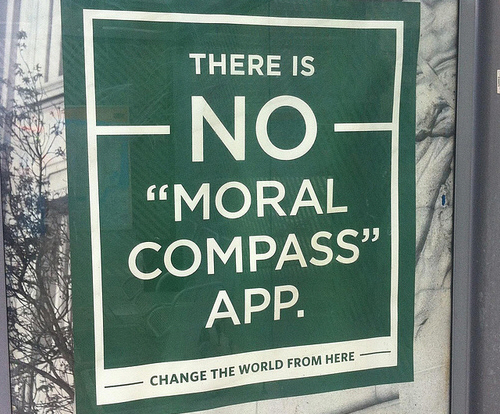
Moral-compass-appIn the advertising film Art & Copy, there’s the following comment from an advertising great: “I always thought advertising was the most whore-ish business a person could get into”.
And in some ways that’s true. After all, an ad agency will help shape an argument/story/perception around almost any organisation’s offering. And to create that perception they tell the story from a particular perspective – a bit like a lawyer defending her client. Or put another way, we act in a similar fashion to mercenaries.

As advertisers, we take the time to understand our clients’ background and see things from a certain point of view. We’re able to step outside of ourselves, adapt and walk in the shoes of the prospective target market in order to find a way to appeal to them.
Throughout my career I’ve seen vegetarians create great ads for the meat and livestock industry. I’ve seen people create successful campaigns for a political party they didn’t vote for. And I’ve witnessed people make particular banks into powerful brands even though, personally, they’d never do business with them.

However, on a personal (and sometimes agency) level, most of us have our limits on the types of businesses, products and organisations we’ll help represent.
Many years ago, I knew a junior copywriter who resigned when asked to work on a tobacco account. And more recently, I read an article about one MD who declared his agency would never work on a gambling client.

For me, I’d be really uncomfortable working for an online gambling business. Not sure why, as I haven’t had firsthand experience of somebody with a serious gambling problem. Maybe online gambling just feels a little too accessible and therefore easy to escalate out of control?

So what about you? Which client would you refuse to work on? A fast-food? A company with a bad environmental record? Alcohol?

DUSTIN LANE
Brand Strategy | Advertising Concepts | Copywriting

Visit risinggiants.co or dustinlanecreative.com

Advertising, without the bullsh*t

bullshit-meter-2We’ve all sat in those meetings when people pull out the latest buzzwords and newfound formulas for success. It reminds me of an old saying: ‘If you can’t dazzle them with brilliance, baffle them with bullshit’.

Don’t get me wrong. I’m all for keeping up with trends, innovation, opportunities and measuring things. I’m just not for the bullshit that many people put with it. Big words, sentences that don’t mean anything, and stuff like this gem below, that crossed my desk last year:

Jargon proposition

It’s jargon. It’s waffle. It’s saying something, without saying anything.
As a piece of communication, it’s severely lacking. It’s one of those things that looks good in a document or presentation slide, but everyone asks in a more private setting, after the meeting, ‘what does that really mean?’

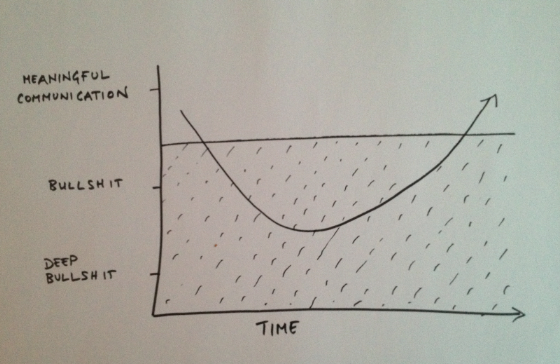
Years ago, the founding partner of an agency I was working at gave a great reason for why people do this. In his career of 30+ years, he realised a pattern. It’s illustrated in the diagram below. Essentially, he said junior people  in the industry wanted to sound more senior, like they knew what they were talking about. As a way of doing this, they use a lot of jargon and industry buzzwords. Then, he said, as people become more confident in their ability and experience, they usually parked these bullshit terms, and tended to speak like people again.

Bullshit graph

Look, we’ve all talked a bit of bullshit at one time or another. I guess the trick is trying to limit or eradicate it from your work.
Or put another way, try and  be an island of reality in a sea of bullshit.

DUSTIN LANE
Brand Strategy | Advertising Concepts | Copywriting

Visit risinggiants.co or dustinlanecreative.com

A successful formula for advertising: realising that there is no successful formula for advertising

Well, it’s the start of a new year. A time when we usually step back and take a look at where things are at. Our fitness. Our finances. Our job. Our relationships. Around this time of year, there’s not much that doesn’t get reassessed. Sometimes we take action, sometimes we don’t.
Unfortunately, it’s also that time of year when the ‘predictions’ lists come out. You know the ones – things like ’10 apps you will need to survive 2014′, ’10 ways big data will reinvent marketing in 2014′, ’10 ways TV will be dead by December’. Many marketers are looking for a formula for success. The problem is that advertising isn’t all science. It’s half art, and art is unpredictable. (Actually, even science is unpredictable if you recall the film Jurassic Park).
Art that is loved by an audience at one point in time might not be so well received at another point in time. Fashion is art. Architecture is art. Music and film is art. And, a large part of marketing is art.
While science can be applied to marketing, there’s certainly no 100% foolproof formula for success (not even the one featured in the video below, explained by David Droga).

DUSTIN LANE
Brand Strategy | Advertising Concepts | Copywriting

Visit risinggiants.co or dustinlanecreative.com

Information, entertainment and a beer with Daz

Recently I caught up with an old mate, Daz, for a beer.

Daz has an interest in a small business called Bark Blowers. Put simply, this service allows customers to have sand, soil, blue metal, pebbles or mulch installed without having to unload/reload on site. Through a powerful pneumatic hose system, you quite literally spray the product wherever you want it.

Recently, they’d done a commercial through a regional TV station. The station produced the ad for very little cost but he was unhappy with it. He said it was wall-to-wall voiceover and seemed like it just yelled ‘heaps of shit’ at the viewer. Knowing I worked in advertising, he asked my opinion on whether ads should be packed full of information, or whether having a strong element of entertainment was more important.

I answered that it’s an age-old topic discussed between advertisers (who tend to support ‘information’) and their agencies (who tend to support ‘entertainment’). Having worked for a regional TV station in a previous life, I also told him that they produced his ad so cheaply because their motive was to give him something he could run on air (where they make their money in air time).

I suggested that these are some things he might like to consider:

  1. Nobody turns on their TV to be yelled at (or even sold to, for that matter).
  2. Information-rich may be received favourably by those viewers who, at the very time of the ad going to air, are in the market for the services of his product.
  3. On the other hand, taking the ‘entertainment’ route  will give your message a longer shelf life, provided it’s done well. This is because good ads get noticed by more people. So, besides getting noticed by those who are currently in the market, the entertainment factor also often appeals to those who are not in the market at that particular time. However, there’s a good chance they’ll recall it in the future if they need that service.
So, in this way, the ‘entertainment’ route gives you more bang for your buck, provided the entertainment part of your ad is relevant. 
However, this  chat with Daz over a beer also highlights another of the challenges facing Adland at the moment – namely, the longevity of an ad or campaign, and how to get the most value from it.
This topic is discussed here, where a few of the readers’ comments suggest the way marketers should rethink their communication strategies.
Similarly, Nick Law from R/GA talks about this subject in a video filmed in 2009.
It might seem that in a ‘throw away’ world, we’ve even made the advertising too disposable.

DUSTIN LANE
Brand Strategy | Advertising Concepts | Copywriting

Visit risinggiants.co or dustinlanecreative.com

ADMA Forum 2011

I was asked to give a talk at the ADMA (Australian Direct Marketing Association) Forum last week – a simple ten-minute presentation showing an interesting example where an organisation has used mail as part of their marketing communications.

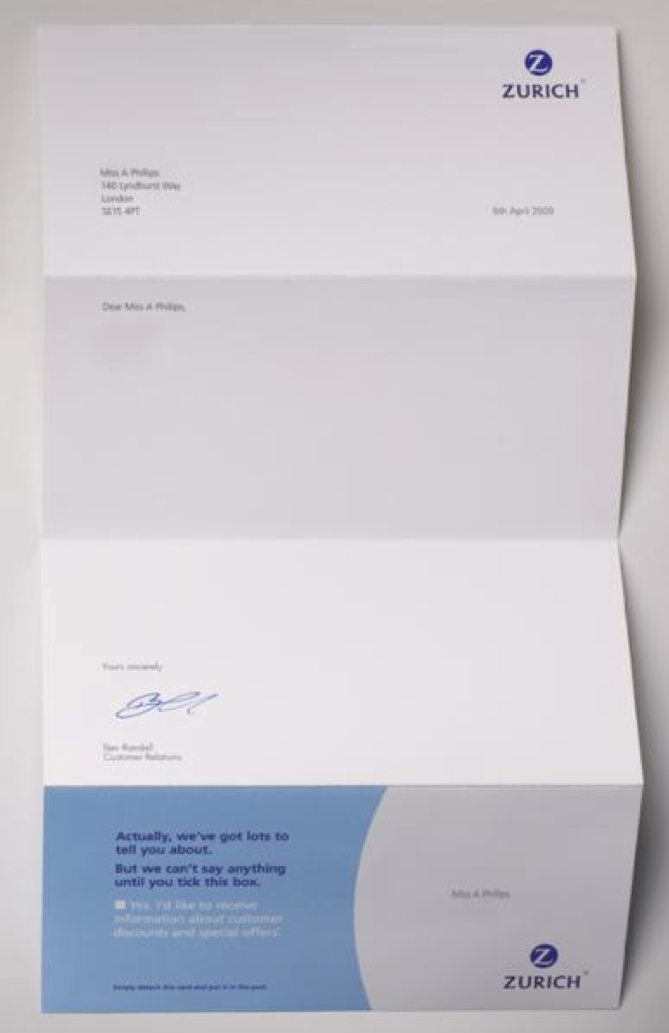
I could’ve found a big, dimensional mail pack with lots of wow-factor but, let’s face it, not many marketers have the budget to do those. So I looked for a nice, simple example of a letter and envelope. And I came across this one from Zurich Insurance, produced by Publicis Dialogue in London (source: Directory, directnewideas.com).

The copy says:

Dear Miss Philips,

Yours sincerely,

<Customer Relations Guy’s name>

Actually, we’ve got lots to tell you about. But we can’t say anything until you tick this box.

Yes, I’d like to receive information about special offers.

According to the case study, the problem was that 25% of Zurich customers had opted out of receiving marketing communications. This letter convinced 7% of recipients to change their mind and opt back in. A pretty good result.

‘Opting out’ is pretty bad news for marketers, because it’s the customer saying, ‘I don’t want to hear from you anymore’. It’s the end of the conversation, and if the customer ended it, it must not have been that good in the first place.

What many marketers don’t really want to acknowledge is that your starting point is this: People don’t care what you have to say.

As blunt as it sounds, it’s true. People are too time-poor and you’re just one of many  organisations yelling and selling at (potential) customers.

So, what’s the solution? Well, it’s pretty simple – don’t create ‘ads’. An ad is something people avoid. Rather than create ads that try and interrupt or invade people’s lives, create something people seek out and engage with. Now, many people might say, ‘People don’t actually seek out ads do they?’ Yes, they do. Provided they’re good and/or relevant enough.

Howard Gossage, muttered these words during the Madmen era, and they’re probably more relevant now than they’ve ever been:

“People read what interests them, and sometimes it’s an ad.”

For example, take a look at The Old Spice Response campaign.

20 million views in the first three days, 40 million in the first week. Website traffic up by 300%, and sales up by 107% – here is a case a people seriously ‘opting-in’ to a brand.

Now, I’m not suggesting we go and make personalised videos every time we want to talk to a customer but there are some important points we can take on board, whatever medium you use…

  1. Successful brands are not defined by a logo, a typeface and a colour palette. Successful brands are defined by what they do and how they do it.
  2. Successful brands push the boundaries. They don’t play by the rules, they rewrite them.
  3. Let your brand speak like a person (i.e ‘Dear <first name> <last name>, As a valued customer…’ is not speaking like a person).
  4. Provided you’re not delivering bad news, have some fun. Fun is infectious. It’s what people want to interact with. If you have fun making your communications, people will have fun watching, reading or listening to them.

DUSTIN LANE
Brand Strategy | Advertising Concepts | Copywriting

Visit risinggiants.co or dustinlanecreative.com