Tag Archives: Dingo’s breakfast

What’s your best ad?

If you’re in the business of creating advertising, you’ve probably heard that question before.
Sometimes it comes from prospective employers, sometimes it’s from friends, and other times it’s from strangers who have recently discovered what you do for a living.
The thing is, it’s rare to have produced an ad where you wouldn’t change at least one thing if given the opportunity. Ads are full of compromises – it might be the size of the logo, or a word you were forced to use in the headline, or even the way the client’s legal team asked you to phrase an offer.
I’m sure even many of the ads that we often hold up as the best, would have parts changed by their makers if permitted.

I wondered if anyone had ever produced a piece of work they were 100% happy with. So I asked.

Years ago, I was in Cannes for the advertising festival with my CD at the time, Warren Brown. It was very late (well, early actually) – the sun was already up, and we were making our way from The Gutter Bar on La Croisette to our hotel. It had been a big night (so I’m pretty surprised I remember this conversation). I asked Warren if he had ever produced an ad where he wouldn’t change a thing. Here was a guy that had been at the top of his game for 3o years, so I held hope that there was at least one ad that he’d produced exactly the way he wanted it. There was.

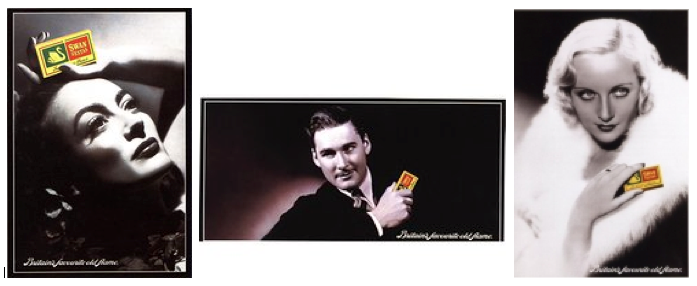
It was a poster campaign for Swan Vestas matches. He said even if he had the chance to do it again, there’s not one thing he’d change.
(Excuse the low-res copy I’ve posted here. The line reads, ‘Britain’s favourite old flame’)
Swan Vestas

As for me, my favourite ad is probably one I did for XXXX beer. It’s not one that received lots of advertising awards. In fact, it didn’t win any. It was a 60-second commercial that predominantly used library footage. And it only aired in one state of Australia during the 2011 State of Origin rugby league series. But I did receive letters from Queenslanders saying how proud it made them feel and thanking me for making it.

What about you? Which of your own ads is your favourite?

DUSTIN LANE
Brand Strategy | Advertising Concepts | Copywriting

Visit risinggiants.co or dustinlanecreative.com

You work in advertising? Are you sure?

Remember that last scene in the 1984 movie, The Terminator?
It’s set at a remote petrol station and we see a young Mexican boy cry something in Spanish. Sarah Connor asks the older attendant what the boy said and the man says, ‘He said there’s a storm coming.’
Sarah Connor looks into the distance and says, ‘I know.’

Sometimes I look at the ad industry and feel like that Mexican boy. Except maybe nobody understands the language I’m speaking, or they’re just in denial because they don’t want it to rain.

But I know I’m not the only one. Nick Law from R/GA gave a talk at Circus – the Festival of Commercial Creativity in Sydney last year.

He put up a slide and said, ‘this is what happens when technology meets industries’. He then proceeded to highlight how technology had changed, or in some cases wiped out, entire industries.
I’m sure former employees of Kodak would agree, and no doubt the bean-counters at various music labels remember this when they have to sign huge cheques for Apple every month.

Let’s look at our situation. Most ad people are working harder than they ever have before. And, relatively speaking, they’re probably doing it for less money than they have before. As an industry, we look like all the animals in Madagascar 2 standing around the ever-shrinking waterhole. It’s happening across a lot of marketing and media areas.

So, how can you prepare for the future?
Well, I think we simply have to ask ourselves what industry we’re really in.

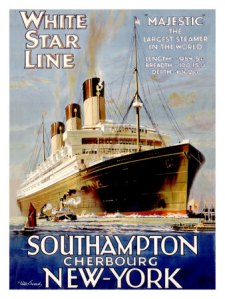
Some years ago, I went to another talk given by Patrick Collister. He used the example of White Star.

White Star

In 1870, White Star formed and would grow to become one of the largest shipping companies in the world. The Titanic was theirs, but that ill-fated voyage isn’t why they’re not around today. They simply didn’t realise what business they were in. They thought they were in the ‘shipping’ business. They weren’t. They were actually in the ‘transport’ business.

Instead of focusing all their efforts on travel by sea, they should have been carefully looking at a new competitor – travel by air. Who knows? If they had, there might be a White Star A380 asking people to put their seats in the upright position overhead right now.

The ad industry has been preaching their answer for a while now. We see ourselves as being in the ideas industry, rather than the advertising industry.

But let me ask you this: how much of your revenue in the past 12 months has come from non-advertising ideas? How many new products have you put to market? What innovative business models have you introduced? How many patents have you lodged?
For people who trade in ideas, it seems we’re still firmly stuck in the advertising world.

I’m sure my high school physics teacher had seen The Terminator, but he didn’t speak spanish. He just used to say, ‘Fail to prepare, and prepare to fail.’

DUSTIN LANE
Brand Strategy | Advertising Concepts | Copywriting

Visit risinggiants.co or dustinlanecreative.com
In advertising, all that glitters isn’t gold

Over the years, a lot has been written about creative advertising awards. And a lot has been written about how they’ve become an industry in themselves.

Copywriters and art directors are often indoctrinated into a strong award-seeking ethic. But creative awards themselves are quite worthless (see the video below), so why the desire?

Well, part of it is due to a creative person’s inherent need for recognition of their work and to find an audience for it. But part of it is also due to the fact that a copywriter, art director or creative director’s salary is often linked directly to winning creative awards (just like a marketing manager’s KPIs might be linked to phone calls, or sales, or hits on a website).

The problem arises when the work collecting the gongs isn’t the same as the work that gets noticed by the target market.

We need to remember that our challenge is to use creativity to solve our clients’ business problems. If you concentrate on that, the rewards can be much richer than just collecting a shiny doorstop. Or as one of my former CDs put it to me, ‘What would you rather have? A Cannes Lion or a yacht?’

My response: ‘If you do it right, you can have both.’

DUSTIN LANE
Brand Strategy | Advertising Concepts | Copywriting

Visit risinggiants.co or dustinlanecreative.com

Tight margins, and what it means for the industry

Years ago, my art director and I were called into our CD’s office for a chat. We’d recently been thinking about moving to another agency and the CD wanted to know what he could do to stop that from happening. Whilst money wasn’t the driver of our decision, it was going to be a factor. I clearly remember him saying this: ‘Every year employees want more money, and clients want to pay the agency less’.

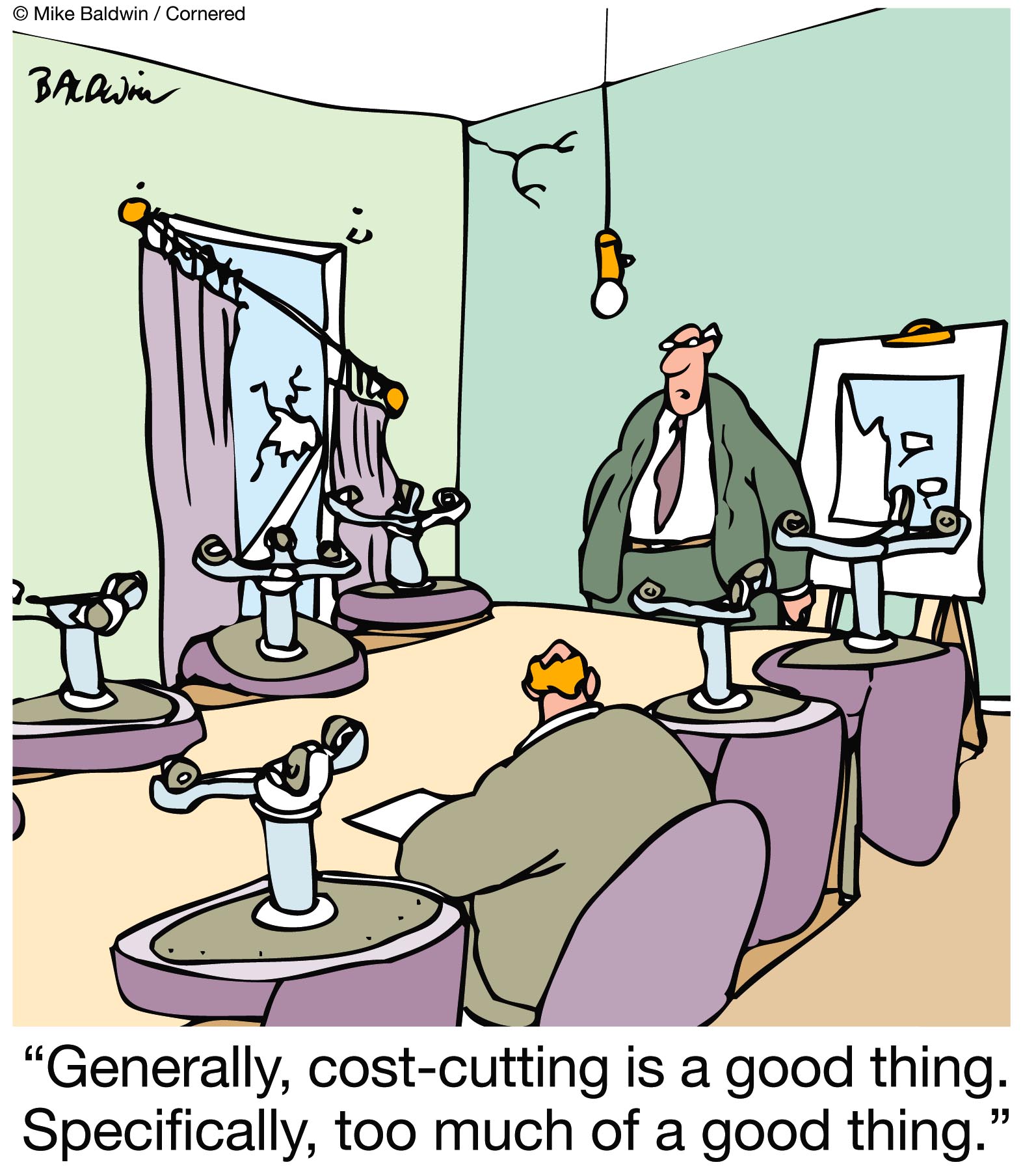
Nothing has changed, I guess. But the situation is getting to a point that simply isn’t sustainable. The other day I bumped into a headhunter (no, I wasn’t looking for a job). I asked her how business was. She said that she’s relatively busy, but nobody wants to hire senior people anymore. All the briefs are asking for mid-weights. The reason, of course, is that senior people come with senior price tags. And as agencies get squeezed tighter on their margins, they’re looking for ways to cut expenses and protect those margins. But, it’s not a long-term solution and it will ultimately impact on the standard of work.

I’m not saying that junior and mid-weight teams can’t do the job. I’m simply saying that they generally don’t hit the target as consistently, and they take longer to get there. Also, less senior people mean less mentors for junior employees.

Another trend that’s emerging is that human resource is becoming more transient. Freelancers are being used more frequently. Agencies are only pulling in people when required on jobs rather than have them on a retained salary.  But, many are also trying to pay them a pro rata rate of what they would pay a permanent person in that role. If freelancers agree to do this, there is little motivation for the agency to hire anyone full-time. Why would they risk having to ‘carry’ employees through quieter times or pay them for holidays, if they can just pick up the phone and have that resource on call at the same price?

So, in short, tighter margins is leading to people working longer hours because agencies aren’t resourcing appropriately. And experienced people are being managed out of the business because they cost too much.

All this means that creative people will increasingly look for careers outside of advertising and traditional agency structures. This recent study by Deutsch puts the writing on the wall.

And of course, once the talent moves on, the client dollars will probably follow.

DUSTIN LANE
Brand Strategy | Advertising Concepts | Copywriting

Visit risinggiants.co or dustinlanecreative.com

Step back and take a look at yourself

If you work in advertising (or for that matter, any field that demands a lot of your time and energy) I strongly recommend you read this:

http://www.lindsredding.com/2012/03/11/a-overdue-lesson-in-perspective/

DUSTIN LANE
Brand Strategy | Advertising Concepts | Copywriting

Visit risinggiants.co or dustinlanecreative.com
What’s in a job title?

It’s funny how a title can influence the way others perceive you, or how it affects whether they buy into what you have to say. There’s been various articles written about it before.

Sometimes an organisation will offer a job title as a poor substitute for a pay-rise. I’ve never really been one for titles though. Apparently, even one of the richest people in Australia, Lindsay Fox, owner of the logistics company Linfox , simply has ‘Truck Driver’ on his business card. I like that.

My business card never said ‘Junior Copywriter’ when I was a junior, and it never said ‘Senior Copywriter’ years down the track. In fact, it has never even said ‘Copywriter’. In the space for the job title, I used to always have ‘Writer’.

Part of the reason is that nobody knows what a ‘copywriter’ does – just ask my mum, or any of the people who have asked me for advice on patents and trademarks.

People can grasp the word ‘writer’. It gives an indication of what you do. But ‘copy’? Well, it’s only inside the industry that people know ‘copy’ refers to text. Everywhere else, ‘copy’ indicates replication, which doesn’t really fit inside the job description of a ‘copywriter’.

However, it seems the guys across the desk from us have a title that ticks almost all the boxes in ‘Art Director’. It’s pretty self-explanatory in that it’s a person who directs the art. Years ago, a student who was spending a week with us on work experience even asked me if I wanted to ‘work my way up’ to the role of Art Director. Obviously, the word ‘director’ gave him the idea that there was some sort of hierarchy thing going on.

I moved into a new office space about six months ago (pics below), taking up residence amongst other creative industry people such as web designers and start-ups, film producers, casting agents, photographers etc. Even these people weren’t sure what a copywriter does. At first, they thought my job was pretty much a typist (and if you’ve ever seen my two-fingered typing style, you would probably ask how I can possibly make a living out of this).

But the thing is, whether you’re a copywriter or an art director, I think writing or directing the art is only a relatively small part of what you do. That’s just the crafting part. All the heavy grunt work, the stuff that takes the most time and effort is coming up with an actual idea.

So what should we be called? ‘Problem Solvers’? ‘Innovationists’? Ideas People’? Or, like the video below, maybe just ‘Steve’?…

DUSTIN LANE
Brand Strategy | Advertising Concepts | Copywriting

Visit risinggiants.co or dustinlanecreative.com

Why do clients pick one ad agency over another?

A lot of marketing dollars from around the world ride on this question. Well, I reckon there are five basic reasons that influence a client’s decision. Each of them play a factor, but every client is different in the  level of importance they allocate to each.

1. Relationship

You see this time and time again, when a marketer moves companies and soon hires an agency they previously worked with. And that’s fair enough. If you have a good relationship with someone that’s tried and trusted then why not go with it?

Also falling into this category is the client that is just looking for a buddy – someone they can call anytime and have a chat with, or someone they can hit the golf fairway with, eat at fancy restaurants with, etc.

2. The Work

By ‘work’, I mean the ideas and the end product that appears on our TV screens, billboards, magazine pages, etc. The purists in agency-land would love to believe that if you get this right, it’s all that matters. And in an ideal world, that would be the truth. ‘Best work wins’, right? Unfortunately, this isn’t always the case.

3. Cost

There’s always an agency willing to do it cheaper. And in recent times, this trend is pushing ad agencies into a position that simply isn’t sustainable. Plus, the work ultimately suffers because lower margins means you can’t afford to have the best people working for you (or giving the time required). There are no winners in a numbers game, only casualties.

4. Resource suitability

Some agencies are organised to fulfil specific needs. A client might want an agency with expertise or processes that suit a particular type of advertising (retail specialists, digital specialists, promotion specialists, fast turn-around stuff,etc).

5. Obedience

Marketers choose this type of agency because it makes them feel powerful, or they feel safe knowing they’ll get pretty much exactly what they ask for, when they ask for it. There is often no room for exploring new options, or unconventional approaches. In many ways, the agency’s role is reduced to that of a  studio. They cease to be partners in solving business and/or communication problems. Their role is simply one of servitude. In this position, creative people’s passion is often snuffed out.

So, if you’re a marketer, where do you place the weight of your criteria? Or if you’re an agency, which ones are your priority? It’s only when the agency and marketer are on the same page that a healthy marriage happens.

DUSTIN LANE
Brand Strategy | Advertising Concepts | Copywriting

Visit risinggiants.co or dustinlanecreative.com

‘Imagine’, a book to add to my reading list

And here’s someone’s 2-minute review:

DUSTIN LANE
Brand Strategy | Advertising Concepts | Copywriting

Visit risinggiants.co or dustinlanecreative.com

Words of wisdom

Whether the outcome of a situation is positive, negative, or neutral, I believe there is always a lesson to be learned in everything we do in life. Sometimes, we simply don’t look for it. And, while I believe in learning from my mistakes, I think it’s even better if I can learn from the mistakes of others.

So about two and half years ago, I began meeting with highly successful people in the advertising industry from around the world. So far they have ranged from Executive Creative Directors, Chief Executive Officers, people who are (or have been) on the Board at large multi-nationals, people who have built their own agencies, people who have been nominated into advertising ‘hall of fames’, and so forth.

Put simply, I just wanted to pick their brains and ask them about their experiences and what they’d do differently if they had the opportunity. So after many chats over coffees, beers and even Skype, here are just a few words of wisdom from those who have been there…

“The biggest realisation that you make is that it’s relatively easy to make the same salary on your own as you do when you’re employed by an agency.”

“Just make the work brilliant. If the work’s consistently good, it’s what gets you on lists, it’s what gets noticed, it’s makes the place fun to work at.”

“As you grow and get more people around you, you feel safer.”

“None of us had much business nous. We didn’t have a solid business model or anything to begin with – it just kind of evolved as we went. The only thing we did know was the kind of work we wanted to be doing and the kind of work we didn’t. You just have to jump in and do it. You learn so much from actually doing it.”

“You need to devote yourself to new business, and make it an ongoing thing. You can get caught in the trap of just servicing existing clients, and when one of them walks, you’re left living hand-to-mouth for six months until you can win something else.”

“Learn about business. Understand how it works, and how they make money. Once you understand business, you have remarkably different conversations with clients. They no longer treat you as the ‘weird creative people’ who just make funny ads (that makes them a bit nervous). If you illustrate an understanding of their business, they treat you differently.”

“It’s better for business if you fire a bad client rather than keep them.”

“As a creative, you’re a problem-solver. If you can keep that in mind, and run a business as one that solves a client’s problems, there really is no difference between being a ‘suit’ and being a ‘creative’. But avoid becoming a ‘client’s studio’ – there is not a lot of long-term value in that.”

“It’s easier to run a business on a retainer because you know what’s coming in and you can staff up accordingly. Also, it’s psychologically easier for a client to pay $10k per month rather than sign a cheque for $120k at the end of the year, even though they’re the same amount.”

“Lease everything. And if you get a place, put all your money into the boardroom. Make it big and make it good.”

“There are enough ‘good’ clients around. It is a balancing act, but if a client is not aligned with you, get rid of them.”

“At the time, I enjoyed the comfort of selling half my business to a holding company, but now I see little value in continuing to give them half the profits of all my hard work.”

“Regardless of the scope of our ideas, I found that unless we actually called ourselves an ‘ad agency’, clients didn’t really know how to deal with us, or which pigeon hole to put us in.”

“For some people, ‘freedom’ is having a place with their name on the door. For me, ‘freedom’ is not having my name on the door and knowing I can walk away tomorrow if I choose to.”

“Decide early on if you’re building a business to sell or a business to allow you to do the kind of work you want to do. That decision will play an important role in some of the choices you have to make down the track.”

“Stay true to the reasons why you started.”


DUSTIN LANE
Brand Strategy | Advertising Concepts | Copywriting

Visit risinggiants.co or dustinlanecreative.com

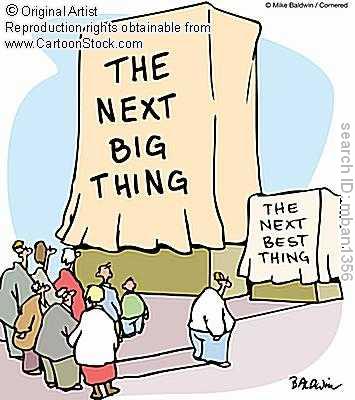
Are you brave enough for ‘the next big thing’?

If you work in advertising, you’ve probably sat in one of those meetings where the client has said that they want a <insert the latest big advertising success here>.

In recent times, this comment has taken the form of ‘We want a Share a Coke’.

Before that, it was ‘We want an Old Spice Guy’.

And before that, it was ‘We want a Best Job’.

I’m sure you get the idea.

However, it reminds me of a friend’s old tweet, which read ‘Most clients want a big, original idea – and three examples of where that idea has worked before’.

This, of course, is a paradox. If something has been done before, it’s not original. And advertising is a business where originality is rewarded with a customer’s interest and engagement.

The truth is, the campaigns mentioned here are the product of great ideas that simply would not have existed without the belief and bravery of the marketers behind them.

For a moment, let’s pretend that none of the ideas above had been done.

With the Coke idea, you’re choosing to make the product brand name considerably smaller and/or replace it with the name of customers. Then there are the logistics of actually printing the new packaging and getting it to market via numerous supply channels.

With the Old Spice Response campaign, the idea is to create on-the-run pieces of film that are each aimed solely at one individual. So in essence, multiple TV ads without media spend, approvals or buttoned-down pre-production meetings, that are aimed at an audience of one.

And with the Best Job In The World, where glossy pictures are the category norm, you’re looking at reducing your ad to the classifieds.

Now, how many marketers can put their hand on their heart and say, ‘Yep, I would buy that’.

There are plenty of things that make these ideas either too hard or too risky. But they say fortune favours the brave. Or, as General Patton said, ‘Courage is fear holding on a minute longer’.

DUSTIN LANE
Brand Strategy | Advertising Concepts | Copywriting

Visit risinggiants.co or dustinlanecreative.com