Tag Archives: Creativity

Big, bold predictions for 2025.

Every year around this time, people make ridiculously bold predictions for the year ahead. In the past, I’ve sat by and watched, wondering how people can be so full of conviction and so full of shit at the same time.

However, this year you don’t have to worry about that because I’ve compiled a definitive and completely genuine list of the five biggest things you can expect to happen in 2025. And remember, you heard it here first.

1. Haircuts

On 20 January, Donald Trump is inaugurated as the 47th president of the United States of America.

Then, while scrolling through old tweets, the big fella comes across a story from 2014, where various news outlets reported that North Korea had made a law requiring all men and boys to have their hair styled in the same way as Kim Jong Un.

Quite taken by the idea, Trump introduces a similar law in the USA, ostensibly as a way to boost patriotism, unite the country, and help make it great again. Subsequently, all American males are soon sporting brilliant Trump-style combovers.

An entrepreneur spots the need for hair products that will better cater to this particular hairstyle and appears on the TV show, Shark Tank, spruiking his new range of haircare products called ‘Hairforce One’. The entrepreneur gets the finance he’s seeking, and Hairforce One goes on to become the fastest-growing FMCG product of all time.

2. Facts on the riviera

Following Zuckerberg’s decision to remove fact checking from Meta, lots of fact checkers find themselves without a job. A few manage to find work on TV quiz shows like The Chase, however most are employed by the Cannes Advertising Festival to check the claims made by ad agencies in the case studies they submit.

Don’t say you weren’t warned.

3. Virtual dining

Seemingly inspired by everyone’s willingness to outsource their thinking to A.I., the wellness industry jumps on board with a new weight-loss treatment. In a similar way to thinking for people, this new product saves people from actually eating. Instead, it simply describes to the user what the food tastes like so they can enjoy the food vicariously, without the calories.

Due to its success, many people are bombarded with telemarketing efforts from competing A.I. dining products, each proclaiming that their descriptions and adjectives are more delicious than others.

Uber Eats even gets in on the act, after realising that it’s quicker and cheaper to send customers an email that describes the meal, rather than have tangible food delivered.

4. True 1-to-1 advertising

As people can no longer believe that what they see on a screen is real, there is a move by advertisers to introduce a new 1-to-1 model to convey their clients’ messages. It involves hiring real people to visit the homes of the intended target audience to deliver an in-person spiel about a product or service.

Of course, they try and portray it as “a new, proprietary” offering and employ designers to create a great-looking slide to represent this in their credentials decks. However, in reality, it seems they just dusted off the old playbook used decades earlier by door-to-door vacuum salesmen and Mormons.

5. Red planet reality

With the objective of creating energy for electrical cars, an unnamed billionaire begins to build his version of The Matrix on Mars. Thousands of influencers sign up to be part of it, reasoning that their life has become such a manicured, fake veneer, this is the logical next step. It’s intended to be a real-life mashup of The Truman Show, Ready Player One, and Fahrenheit 451.

Of course, in the meantime, if you’d like to keep things real and do some good, no-nonsense work, contact dustinlanecreative.com

DUSTIN LANE
Brand Strategy | Creative Concepts | Copywriting
risinggiants.co

Is the advertising industry sailing in the right direction, or is it time to jump ship?

Lately, there’s been a lot of talk about change in the industry due to a number of factors – the advent of new A.I. not least among them.

And that brings to mind a couple of stories (please bear with me here – there is a point. If it helps, maybe imagine me sitting on a rocking chair, wearing a cowboy hat while I peel a piece of fruit and eat the pieces straight off the knife).

Story 1: The Boat

A few years ago, my daughter took Philosophy as a subject at school. I was happy about that as it would teach her to contemplate and consider things – essentially, to ‘think’, rather than simply memorise and regurgitate information.

Anyway, she would sometimes share with me the content of a particular lesson or an anecdote the students had been given.

One such discussion was this:

Imagine you’re on a boat.

The boat leaves Port A, destined for Port B.

Throughout the journey, parts of the boat are replaced – a new plank of wood here, a new fitting there, a new sail and so forth.

Ultimately, we get to a stage where every single piece of that boat has been replaced. Every plank. Every fitting. Every sail.

The boat arrives at Port B.

Is the boat that arrived at Port B the same boat that departed from Port A?

It’s certainly something to consider.

Now, for shits and giggles, let’s call that boat ‘The advertising industry’.

While you ponder that, let’s continue.

Story 2: The Paper

In a previous life, prior to being an advertising creative, one of the jobs I had was working for a regional newspaper. That newspaper was owned by a media company that owned around 29 other newspapers, all based in different towns spread throughout the state.

Of course, the bean-counters at the parent company soon realised they could centralise their printing for all the different newspapers rather than maintain a number of costly printing presses. So, they did, and started to print all 30 mastheads at one location, using one printing press.

Now, there were people who used to work on the other 29 printing presses, so the parent company sought to find them other jobs within each location.

My particular location was not the one that now did all the printing, so I got to see firsthand people who had worked on the printing press now placed in jobs working as graphic designers, laying out ads by desktop publishing on a computer. This was quite a different role than working on the printing press and, with all respect to those people, graphic design was probably not their forte.

Sure, taking a very primitive view, one might say ‘both jobs involve pushing buttons with the aim of creating a printed item’, but beneath that, there’s a myriad of differences. Knowledge or skill in things like operating printing machinery, printing blocks, and print runs, does not translate into designing layouts, visual communication and artwork.

While the outcome is the same – a published ad – the job to get there is miles apart.

It’s kind of like someone who loves horses being approached by Henry Ford saying, ‘Hey, you work in transport. How about coming over to my factory and helping put car engines together?’


Why am I telling you this?

Well, I guess both these stories land in the same place, which is ‘at what point does something evolve so much that it becomes something completely new?’

There’s already been plenty written about A.I. platforms like Midjourney and ChatGPT.

Depending on where you read it, and who it’s written/promoted by, it ranges from point A to point C, below:

A) “Everyone’s job is f*cked”
Some think A.I. will make many people’s jobs redundant.
For example, is it really that difficult to envisage a world where ChatGPT writes a script which then progresses into a later version of Midjourney to produce a finished ad/film/TV show?

B) “This is a kick-ass tool”
Some think that A.I. will be a great ‘assistant’, effectively looking after the more tedious chores within a project so they can get on with the bigger thinking.

C) “A.I. produces crap”
Others think that there’s nothing to be worried about because the output of A.I. isn’t great (yet!). But let me ask you this, how many clients are actually buying ‘great’. Once reviewed by a committee and research, greatness is easily undone. In some cases, clients don’t even care for ‘good’. Often it just needs to be ‘good enough’. This is why there’s so much rubbish out there.

So, whichever school of thought you belong to – A, B, or C – the two stories above tell us three things:

Stand back and have a close look at how much your boat has changed. If you’re not on the boat that suits you, it might be worth jumping to a new one or, better yet, building your own.

Whether something is an evolution or a revolution comes down to your perspective.

There will always be a need to ponder and think. How that actually manifests itself or pays the bills in the future is up to you. Essentially, that’s your brief.

Oh, and speaking of briefs, if you have one, or a project you’d like me to work on with you, let’s chat.


DUSTIN LANE
Brand Strategy | Creative Concepts | Copywriting

Visit risinggiants.co or dustinlanecreative.com

‘Where did the creatives go?’ (Part 1)

Many years ago, while I was at university, one of my friends (also studying communication / advertising) remarked, ‘I wonder where all the art directors and copywriters go when they get older. You don’t see many in ad agencies.’ However, we didn’t spend too much time pondering (it was Bar Night at uni and we were in a hurry to get to $1 Drinks).
Many years later, that question still seems largely unanswered.

Look at the creative departments of ad agencies – they’re all stacked with people in their 20s and 30s. But where are the older creatives? You know, the ones you once showed your book to and gained mentorship from. Surely they haven’t put enough cash aside to retire at 40? Where do they go for the second half of their careers?

Some might start their own agencies. Maybe others find variations of their job, using their skill set outside of the hectic pace of ad agency life. And perhaps there would be those who walk away from the advertising business altogether.

Some time ago, I set out to find the answers…

Part 1: Matt Cumming
Thursday, 31 July 2014
I met with Matt at a café in North Sydney. I hadn’t seen him for a few years. He looked well. He was in Sydney working on a project but later that day, boarded a plane and returned to his rural home on the far north coast of New South Wales.
So, how does an advertising creative end up living on a coastal farm? This is his story:

Matt Cumming

Matt Cumming

I entered the industry as an AFA (Advertising Federation of Australia) trainee in 1985. The traineeship required me to spend time within different departments of an ad agency, but when I got to the Creative Department I simply stayed there.

The agency was Dancer Fitzgerald Sample – a US-based agency that held the global Toyota account. They had set up an office in Sydney to service the Australian market for Toyota.

At that stage, my time in the Creative Department was spent primarily using my illustration skills to create storyboards.

To progress my career as an art director, I then did AWARD School. That course had only been running for a few years and was set up by the industry to help foster aspiring art directors and copywriters. It’s still the most popular way for people to get a job in the creative department of an Australian agency.

After AWARD School I teamed up with a young writer named Danny Ginges.
(Incidentally, at the time of our meeting Danny was in New York, where he’s operating a successful musical called Atomic.)

Dancer Fitzgerald was then bought by Saatchi & Saatchi. Saatchis seemed to be buying everything at the time and, in this case, they essentially bought the Toyota account. By that time, Danny and I had earned a reputation at the agency as being a fairly good team, and our new bosses – Bob Isherwood and Ron Mather – kept us on.

It was a good creative department with plenty of people who would go on to accomplish many things in the ad industry. I was working alongside people like Matt McGrath, Paul Fishlock, Tom Moult and others. I stayed there for around 5 years, and then the recession hit.

The recession meant retrenchments right across the industry, of which I was one. However, because of all the retrenchments there was plenty of freelance work around.

Anyway, I used the payout Saatchis gave me to produce a play. It was a fun thing to do, although it was fairly stressful and I didn’t make any great profits from it.

My next stint was at The Ball Partnership. Tom Moult had become the CD there, and I stayed there for another 5 years before taking 6 months off to go travelling.

When I returned from my travels, The Ball Partnership had been bought by Euro RSCG. Tom Moult was still the CD, and the internet was in its infancy.

Tom said, ‘You like the internet. I’ll give you a room, a computer and a year.’
That was the birth of their Digital Department. After a year, enough was happening with it to justify its existence. I had poached Brendan Tansey from our print studio, and we were good at just jumping in and getting stuff done rather than sitting around talking about it.

My role with Euro’s Digital Department continued for a few more years, until Tom left. Then they gave me his job as Executive Creative Director.

The agency was doing well but it was challenging. Volvo kept changing Marketing Directors, and subsequently pitching. After the third pitch, I left to go surfing.

Leaving Euro felt good. It was quite brave to leave a big salary and not know what I was going to do.

After 6 months of surfing I got bored. I came back to Sydney and wrote a list of 6 agencies I’d like to work for. It comprised 3 agencies who I respected due to the work they did, and 3 agencies included on the basis of ‘they’d probably pay shitloads’.

I then created a direct mail pack to send to all 6 agencies, informing them that I was back, I was excited about one-to-one marketing (both digital and direct), and that I’d like to work for them.

The mailing got a 100% response rate with replies from all 6 recipients, and interviews with senior people at 5 of those agencies. There were job offers from 3 of them.

I chose M&C Saatchi. I respected their work and Andy Pontin, the MD, was fairly impressive. They also had a good IT infrastructure in place. From my time at Euro, I knew I’d need that help and support to grow the agency’s digital capabilities.

The M&C Saatchi bosses, Tom McFarlane and Tom Dery, were wary of digital as they’d been burnt before by people who over-promised and under-delivered. However, clients were starting to grow into the digital space and were willing to pay for the services of a Digital Creative Director.

After 6 years at M&C Saatchi, I left to go surfing once again. By then, my wife and I had a house in Bronte (Sydney’s eastern suburbs) and a holiday house at Sussex Inlet (on the New South Wales south coast). We decided to rent out our Bronte home and try living at Sussex Inlet for a while.

We lived in Sussex Inlet for 8 months. Our kids went to school down there. I joined the sailing club. Living in a town of only 3,500 people was a lot different from the hustle and bustle of Sydney.

We returned to Sydney and I worked at a place called Bienalto – a digital analytics and solutions company. They felt like a family business. You had lots of freedom and client contact and no agency politics. I stayed there for about 18 months before a headhunter approached me for a job at another ad agency – Lavender.

I stayed at Lavender for 6 months but it just wasn’t for me, and by now I was looking for a bigger break. By that stage my wife and I had a block of land at Byron Bay (the far north coast of New South Wales). We were looking at selling it to fund our life in Sydney, but instead chose to sell our Sydney home and live at Byron Bay, downsizing my commitment to advertising.

I’ve been in Byron Bay for 2 years now. We live on a 2-acre block of land but share 80 acres with our neighbours. It’s not a commune – more like a gated community in a rural setting.

Within that community there are different jobs, and one of my roles is to keep the lawn mowed. When you have 80 acres, mowing the lawn means having cows. So my job is to move the cows around. Every year the cows have calves that are then sold to offset some of the community’s maintenance costs. But cattle farming isn’t the reason for having them, lawn mowing is.

It’s a much easier life up there. So far, we’ve built our house and I help look after the kids. My wife is a hair and make-up artist, so she’s often travelling around the country for work.

DSC_4552

The building of Matt’s house at Byron Bay.

I’m currently working on writing and directing a music video for a local artist. Byron Bay is a good place. There are lots of smart people there, lots of retired business people, good food and entertainment. I still work in advertising. I usually work remotely and come to Sydney or Melbourne when I have to, for things like presentations and the like.

I take most briefs via phone or email, with work increasingly from clients directly rather than via agencies. They’re mostly people who have heard of me through someone else and require the services of a consultant.

Looking back, I realise I resigned every 5 to 6 years, just to refresh and recharge rather than jump straight into another job. As a creative, you’re ‘always on’ and I don’t think anyone can maintain that over an extended time. There’s always a deadline or a live brief that’s ticking over in your mind. You can’t love the work if it’s month upon month of tight deadlines and working weekends.

It’s important to ‘jump out’ every once in a while to refresh. That’s why I would go surfing or travelling. I hadn’t saved heaps of money, but I had enough so I wasn’t stressed about it. I wasn’t overburdened by the mortgage. I just needed time out.

This last ‘time out’ has been my biggest. I don’t have the energy I did when I was 30. I wouldn’t come back to a full-time position right now, but that’s not to rule it out in the future. I’m enjoying the bits and pieces I do now as a consultant. I still get excited about the work.

I think this is the new form of retirement. I think people chose to ‘taper down’ and shift to a more reasonable work/life situation. That way, they can continue it for a longer time. I’m still only 53, and with the younger of my 2 kids still in the early years of primary school, I plan on being around for a while yet. I’m just going to pace the rest of my life better.
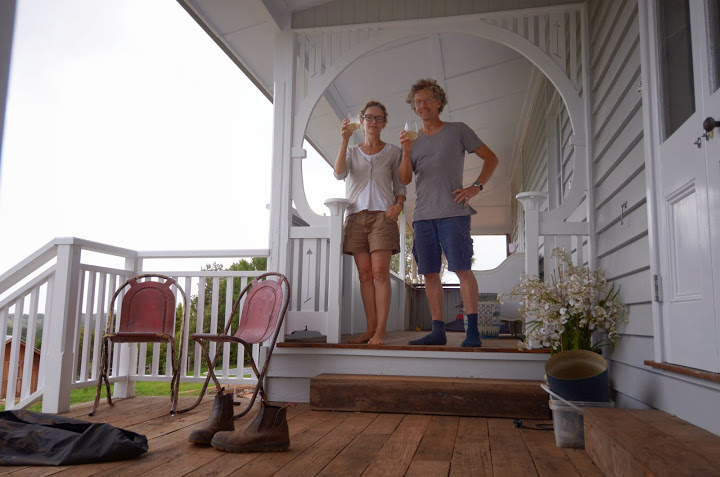
Matt Cumming Advertising

Matt and his wife Annette at their Byron Bay house.

I think the absence of older people in the creative departments of ad agencies is because we’re all commercial artists. At some point, we say to ourselves, ‘I want to do more art’. We find ways to apply our ideas and thinking without it necessarily being through advertising.

Note: Matt has remained true to his ‘time out to recharge’ ethos, and since the time of writing, has leased his Byron home and returned to Sydney with his family.

DUSTIN LANE
Brand Strategy | Advertising Concepts | Copywriting

Visit risinggiants.co or dustinlanecreative.com

Are ad agencies and creativity getting a divorce?

I look at the advertising industry these days and it often looks like the side of a spanner is being used as a hammer. Or to put it simply, it’s not the right tool for the job, but we’re trying to make it work.
But before we discuss that, it’s probably worth a quick look at how we got here (but if you want to skip the history lesson, just scroll down):

1841 – A chap named Volney B. Palmer sets up what is believed to be the first ad agency in Philadelphia. His clients create the ads and he places them in newspapers. (So these days, we’d probably refer to him as a Media Agency).
Ultimately, it was this media placing that gave birth to  a commission-based remuneration model for the advertising world.

Early 1900s – The Industrial Age arrives and with it comes mass-produced products. With mass production, manufacturers began to differentiate their products through branding and packaging.

1922 – Broadcast radio realises that it can fund its existence through advertising.

1929 – The Stock Market crash puts greater pressure on advertising to prove its effectiveness, so research becomes a player.

1938 – Radio ad revenue surpasses that of magazines.

1941 – The first TV commercial for Bulova Clocks airs. At this stage there are only 4,000 television sets, but by 1954 CBS becomes the largest advertising medium in the world.

1960 – The creative team of Copywriter and Art Director is born at DDB.

The 1980s – Personal computers make desktop publishing easier.

2000 – The Internet has 400 million users, making it the fastest growing medium ever.

So history shows that ad agencies were born to allow marketers to communicate with their customers. They did this through interrupting media that the customers were already reading/watching / listening to. To negate this ‘interruption’, creativity was engaged to make the message seem more informative or more emotive, or a point of difference.

However for many marketers, the relationship with creativity has always been an uneasy one. That’s because, understandably, marketers seek certainty. Creativity, by its very nature, isn’t certain. Creativity is unpredictable. At times, it can be erratic and wild.

And sometimes, creativity simply isn’t the answer.
Just recently I had lunch with a friend who left the agency world a few years ago to go client-side. He’s now National Head of Managing Something Or Other. He said that with a lot of the work they do, creativity just tends to get in the way.

This kind of thinking is happening in a lot of places.

It also reminded me of a recent article about former advertising creative, Yanni Pounartzis. In that article, Yanni suggests that creatives won’t exist in agencies in the near future.
I’ve seen this first hand. There are agencies out there that simply don’t have a creative department or ‘creatives’. In many ways, it does seem that ‘advertising’, as we know it, will simply become the management of data.

I do think creativity will live on. That’s what it does. It will find a new home.
But if you were unencumbered by history and were building a business today for the purpose of communicating with customers, I doubt that an ‘ad agency’ is what you would end up with.

DUSTIN LANE
Brand Strategy | Advertising Concepts | Copywriting

Visit risinggiants.co or dustinlanecreative.com

Energy trumps talent: tips from Lord Jeffrey Archer

The other weekend, a TV show called The Bottom Line featured a good interview with Lord Jeffrey Archer. You can see a video of the interview here.
It’s a useful way to spend 22 minutes. But if you haven’t got 22 minutes to spend, please take away these words of his (from around the 8:22 mark):

If you have energy and no talent, you’ll still be alright.
If you have energy and talent, then you’re really lucky.
If you have no energy, but you have talent, you could be in a lot of trouble.

Creativity is not linear. Actually, it’s like bacteria.

The ad below screened on TV years ago, but the other day it popped into my mind again.
https://www.youtube.com/watch?v=h9VWF1DXQ8s

In particular, it was the part that says, “in the last five metres of braking, you wipe off half your speed”.
See, I’d just taken a brief with very tight timings and the accounts person was trying to schedule a review. They suggested that they check in at the half-time mark and see how the work was looking. I told them that wouldn’t work (in fact, I knew it would only make them panic).

Put simply, at the half-way mark, you’re not going to have half the ideas done. It just doesn’t work that way. That’s why most pitches come together right at the last minute (usually over cold pizza, at 3am, while sitting in the agency wondering how you can function on so little sleep).

Instead, the creative process can be a little bit like bacteria, like this video below shows. (After 91% of the time had passed, bacteria fills only 3% of the bottle)
https://www.youtube.com/watch?v=x5OYmRyfXBY
So, don’t stress when a lot of the allocated time has passed and there’s not much work to show yet. It’s normal.

DUSTIN LANE
Brand Strategy | Advertising Concepts | Copywriting

Visit risinggiants.co or dustinlanecreative.com

John Cleese on Creativity

If you have 36 spare minutes, this is a good way to spend them…