
I was asked to give a talk at the ADMA (Australian Direct Marketing Association) Forum last week – a simple ten-minute presentation showing an interesting example where an organisation has used mail as part of their marketing communications.
I could’ve found a big, dimensional mail pack with lots of wow-factor but, let’s face it, not many marketers have the budget to do those. So I looked for a nice, simple example of a letter and envelope. And I came across this one from Zurich Insurance, produced by Publicis Dialogue in London (source: Directory, directnewideas.com).
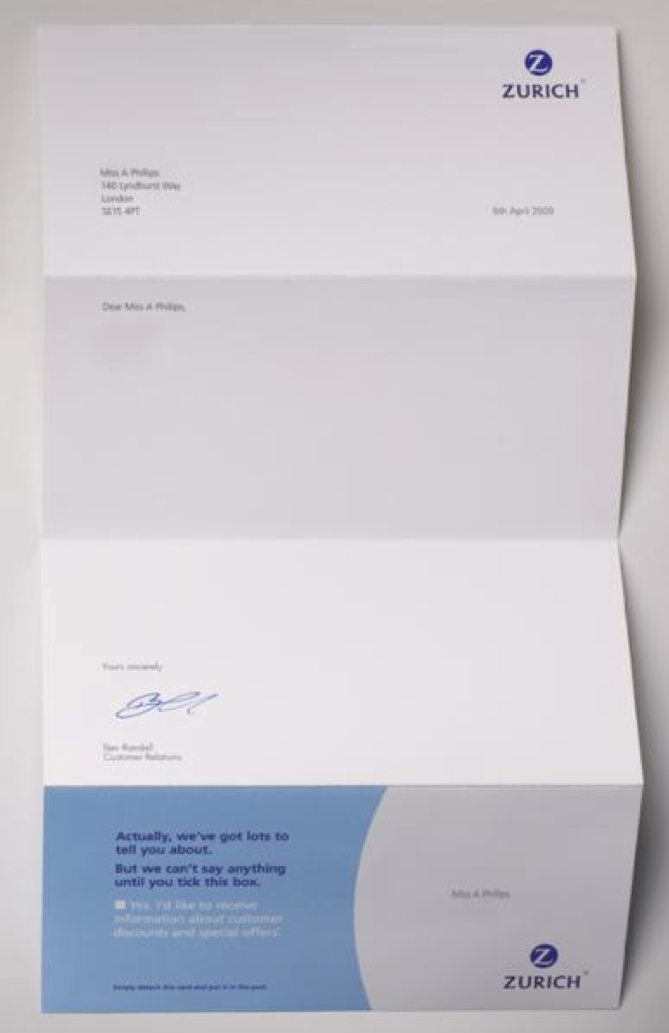
The copy says:
Dear Miss Philips,
Yours sincerely,
<Customer Relations Guy’s name>
Actually, we’ve got lots to tell you about. But we can’t say anything until you tick this box.
Yes, I’d like to receive information about special offers.
According to the case study, the problem was that 25% of Zurich customers had opted out of receiving marketing communications. This letter convinced 7% of recipients to change their mind and opt back in. A pretty good result.
‘Opting out’ is pretty bad news for marketers, because it’s the customer saying, ‘I don’t want to hear from you anymore’. It’s the end of the conversation, and if the customer ended it, it must not have been that good in the first place.
What many marketers don’t really want to acknowledge is that your starting point is this: People don’t care what you have to say.
As blunt as it sounds, it’s true. People are too time-poor and you’re just one of many organisations yelling and selling at (potential) customers.
So, what’s the solution? Well, it’s pretty simple – don’t create ‘ads’. An ad is something people avoid. Rather than create ads that try and interrupt or invade people’s lives, create something people seek out and engage with. Now, many people might say, ‘People don’t actually seek out ads do they?’ Yes, they do. Provided they’re good and/or relevant enough.
Howard Gossage, muttered these words during the Madmen era, and they’re probably more relevant now than they’ve ever been:
“People read what interests them, and sometimes it’s an ad.”
For example, take a look at The Old Spice Response campaign.
20 million views in the first three days, 40 million in the first week. Website traffic up by 300%, and sales up by 107% – here is a case a people seriously ‘opting-in’ to a brand.
Now, I’m not suggesting we go and make personalised videos every time we want to talk to a customer but there are some important points we can take on board, whatever medium you use…
- Successful brands are not defined by a logo, a typeface and a colour palette. Successful brands are defined by what they do and how they do it.
- Successful brands push the boundaries. They don’t play by the rules, they rewrite them.
- Let your brand speak like a person (i.e ‘Dear <first name> <last name>, As a valued customer…’ is not speaking like a person).
- Provided you’re not delivering bad news, have some fun. Fun is infectious. It’s what people want to interact with. If you have fun making your communications, people will have fun watching, reading or listening to them.
DUSTIN LANE
Brand Strategy | Advertising Concepts | Copywriting
Visit risinggiants.co or dustinlanecreative.com


 dingosbreakfast.com