
Well, it’s that time of year again. When thousands of advertising people flock to the French Riviera to look at advertising, judge advertising, talk advertising, and listen to presentations on advertising.
But (and I’m going to throw the cat amongst the pigeons here) how much of it is genuine? No, I’m not talking about the scam work, although that’s a strong talking point (as shown here, here, and here).
I’m talking about whether Cannes has become more about the sizzle rather than the sausage. It seems to be more veneer than substance. I think Micah Walker summed it up pretty well when asked about his judging experience a few years ago. He said he spent the whole week watching case study videos which were, ultimately, an ad for the ad.
Isn’t that a bit like watching the trailer to decide which movie wins an Academy Award? Or which author wins the Man Booker Prize by watching the movie adaption?
In some cases, the actual work doesn’t even get judged. For example, if you had a campaign consisting of 4 TV ads, 3 radio ads, and a couple of print ads, the judges would probably only see how you presented that within a 2 minute case study (the TV ads alone would take that much time if they were 30’s).
And then there is the criteria. Sure, judging things like ads is highly subjective.
But let’s just take a look at one of this year’s big winners – the Live Test Series for Volvo Trucks. (I’m not picking on this campaign. For the record, I like it a lot. I’m simply using it to demonstrate my point because most people are familiar with it, and it won a heap of Lions, including 2 Grand Prix)
Firstly, there’s nothing particularly original about carrying out extreme demonstrations to highlight relevant product features. Just a few years ago, Cannes awarded Google for their Chrome work, and there is always Abbott’s famous print ad (also for Volvo).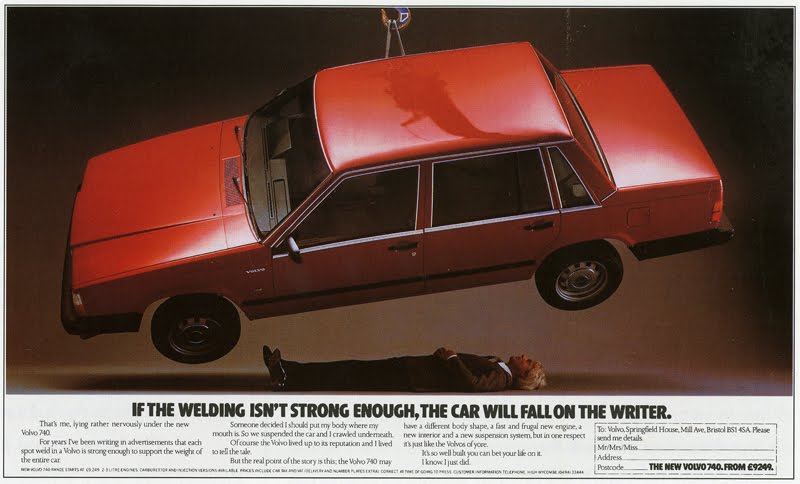
However, the thing that I find the most profound about the Volvo Trucks case study is that it doesn’t mention the sale of a single truck.
The results section of the case study cites the following:
– 100 million views on YouTube
– 8 million shares online
– Thousands of spoofs (spawning an extra 50 million views)
– The Volvo Trucks fan base grew on YouTube by 1870%, 1375% on Facebook
– Earned media to the value of $170 million
– A 46% increase in consideration amongst truck buyers
I know I’m taking a very simplistic view of things here (like the purchase cycle of a large investment item like a truck, the limited time an awards jury has to view and assess work, and the obvious cultural differences that may not translate well). However, I do know that companies can’t pay bills with Facebook likes. Sooner or later, this kind of stuff has to have real, tangible results.
Sometimes, you can lose sight of that, particularly in a place like Cannes. Don’t get me wrong. It is is a great place. However it’s easy to take a warped view on reality there. The weather, the people, the cars, the yachts.
When I first went, I found the talks and gallery of work to be truly inspiring. But I also remember walking through the finalists on exhibition in the Palais and thinking, ‘Wow, Amnesty International must do more advertising around the world than Proctor & Gamble’.
DUSTIN LANE
Brand Strategy | Advertising Concepts | Copywriting
Visit risinggiants.co or dustinlanecreative.com

 dingosbreakfast.com