

Tag Archives: AI

In advertising, perception is everything.

Each morning, I have a coffee and look at the beach. There’s usually a lot of pondering involved. Sometimes, it’s deep pondering on the workings of the universe, and other times it’s more superficial, like ‘why isn’t the letter ‘w’ called ‘double v’ rather than ‘double u’? Or, wondering if Volvo drivers are secretly happy now that the world has Tesla drivers.

Anyway, this pondering changed direction when I saw a person walk past with their phone perched in a gimbal while they did a ‘walk and talk’ video. This prompted me to think about where advertising is at the moment, and where it’s headed.

In simple terms, you could say that advertising’s job IS perception. After all, it creates, manipulates, and manages how a product is perceived.

But what about the ad industry itself – how is it perceived?

Apparently, size does matter.

It seems advertising used to be a bigger deal.
Big, mass media.
Big ideas.
Big productions.
Big budgets.
Big salaries.

Everyone knew it, from banks to breweries.

But then, things got smaller.
Media splintered, and catered to smaller audiences.
Screens got smaller.
Timelines got smaller.
And budgets and salaries followed.

Perception plays a role here.

If the screen is smaller, and the audience is a single person rather than multiple people gathered to view a single screen, it’s no longer perceived as ‘big’. The grandeur is gone.

In the ad industry, when the internet first started making inroads, we all became familiar with a client’s production budget shrinking to reflect the media in which the ad would be shown. Many clients expected the production of a 30-second film to be much cheaper if it was ‘only going online’.

Can you imagine what a car dealer would tell you if you went into a showroom and wanted to buy a car for a cheaper price and offered the rationale that you’d only be driving it on particular roads?

When cost-cutting kills more than your costs.

Most people would be familiar with the old triangle of values: ‘Quality, Time, Cost – have any two’. It’s based on the premise of two values coming at the detriment of the third (i.e. you can have the work done well and quickly, but it won’t be cheap OR you can have the work done well and cheaper, but it’ll take time OR you can have the work done cheaply and quickly, but it won’t be good).
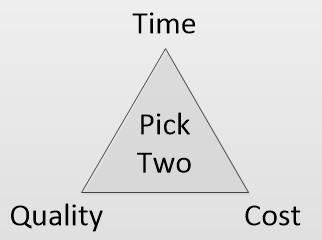
(I was always of the opinion that quality wasn’t expendable, so one of the other two values had to be sacrificed. Not all marketers agree.)

Then, along came generative A.I.
And, with it, the promise that you can have all three values.

Now, whether it currently delivers on quality is up for debate. Problems with image continuity, anatomy, and receiving what you actually requested is still an issue. But we all know the tech will eventually get there.

So, what then?

Well, that’s when perception might really come into play.
Right now, it’s being over-looked, either unconsciously or otherwise.

Perception doesn’t appear on a spreadsheet.

When people know that something has taken effort, they assign a higher value to it.
It’s why people get their photo taken in front of the Sydney Opera House.
It’s why people appreciate a beautifully prepared meal.
And, it’s why brands put the words ‘hand-made’ on labels.

However, when we get to that stage where people will know, or assume, that someone has simply punched in a few prompts to create something, that same value is unlikely to be assigned.

Instead, the output becomes highly disposable.

The inference by the viewer/reader/listener is ‘that business has not bothered to invest in their message, so why should I invest my time in it?’

Of course, consumer psychology like this doesn’t show up on a marketing spreadsheet, but it’s something that needs to be considered.

After all, once everyone has seen behind the curtain and knows how the magician does his tricks, the magic itself disappears.

DUSTIN LANE
Brand Strategy | Creative Concepts | Copywriting

Visit risinggiants.co or dustinlanecreative.com

Is the advertising industry sailing in the right direction, or is it time to jump ship?

Lately, there’s been a lot of talk about change in the industry due to a number of factors – the advent of new A.I. not least among them.

And that brings to mind a couple of stories (please bear with me here – there is a point. If it helps, maybe imagine me sitting on a rocking chair, wearing a cowboy hat while I peel a piece of fruit and eat the pieces straight off the knife).

Story 1: The Boat

A few years ago, my daughter took Philosophy as a subject at school. I was happy about that as it would teach her to contemplate and consider things – essentially, to ‘think’, rather than simply memorise and regurgitate information.

Anyway, she would sometimes share with me the content of a particular lesson or an anecdote the students had been given.

One such discussion was this:

Imagine you’re on a boat.

The boat leaves Port A, destined for Port B.

Throughout the journey, parts of the boat are replaced – a new plank of wood here, a new fitting there, a new sail and so forth.

Ultimately, we get to a stage where every single piece of that boat has been replaced. Every plank. Every fitting. Every sail.

The boat arrives at Port B.

Is the boat that arrived at Port B the same boat that departed from Port A?

It’s certainly something to consider.

Now, for shits and giggles, let’s call that boat ‘The advertising industry’.

While you ponder that, let’s continue.

Story 2: The Paper

In a previous life, prior to being an advertising creative, one of the jobs I had was working for a regional newspaper. That newspaper was owned by a media company that owned around 29 other newspapers, all based in different towns spread throughout the state.

Of course, the bean-counters at the parent company soon realised they could centralise their printing for all the different newspapers rather than maintain a number of costly printing presses. So, they did, and started to print all 30 mastheads at one location, using one printing press.

Now, there were people who used to work on the other 29 printing presses, so the parent company sought to find them other jobs within each location.

My particular location was not the one that now did all the printing, so I got to see firsthand people who had worked on the printing press now placed in jobs working as graphic designers, laying out ads by desktop publishing on a computer. This was quite a different role than working on the printing press and, with all respect to those people, graphic design was probably not their forte.

Sure, taking a very primitive view, one might say ‘both jobs involve pushing buttons with the aim of creating a printed item’, but beneath that, there’s a myriad of differences. Knowledge or skill in things like operating printing machinery, printing blocks, and print runs, does not translate into designing layouts, visual communication and artwork.

While the outcome is the same – a published ad – the job to get there is miles apart.

It’s kind of like someone who loves horses being approached by Henry Ford saying, ‘Hey, you work in transport. How about coming over to my factory and helping put car engines together?’


Why am I telling you this?

Well, I guess both these stories land in the same place, which is ‘at what point does something evolve so much that it becomes something completely new?’

There’s already been plenty written about A.I. platforms like Midjourney and ChatGPT.

Depending on where you read it, and who it’s written/promoted by, it ranges from point A to point C, below:

A) “Everyone’s job is f*cked”
Some think A.I. will make many people’s jobs redundant.
For example, is it really that difficult to envisage a world where ChatGPT writes a script which then progresses into a later version of Midjourney to produce a finished ad/film/TV show?

B) “This is a kick-ass tool”
Some think that A.I. will be a great ‘assistant’, effectively looking after the more tedious chores within a project so they can get on with the bigger thinking.

C) “A.I. produces crap”
Others think that there’s nothing to be worried about because the output of A.I. isn’t great (yet!). But let me ask you this, how many clients are actually buying ‘great’. Once reviewed by a committee and research, greatness is easily undone. In some cases, clients don’t even care for ‘good’. Often it just needs to be ‘good enough’. This is why there’s so much rubbish out there.

So, whichever school of thought you belong to – A, B, or C – the two stories above tell us three things:

Stand back and have a close look at how much your boat has changed. If you’re not on the boat that suits you, it might be worth jumping to a new one or, better yet, building your own.

Whether something is an evolution or a revolution comes down to your perspective.

There will always be a need to ponder and think. How that actually manifests itself or pays the bills in the future is up to you. Essentially, that’s your brief.

Oh, and speaking of briefs, if you have one, or a project you’d like me to work on with you, let’s chat.


DUSTIN LANE
Brand Strategy | Creative Concepts | Copywriting

Visit risinggiants.co or dustinlanecreative.com