Tag Archives: advertising

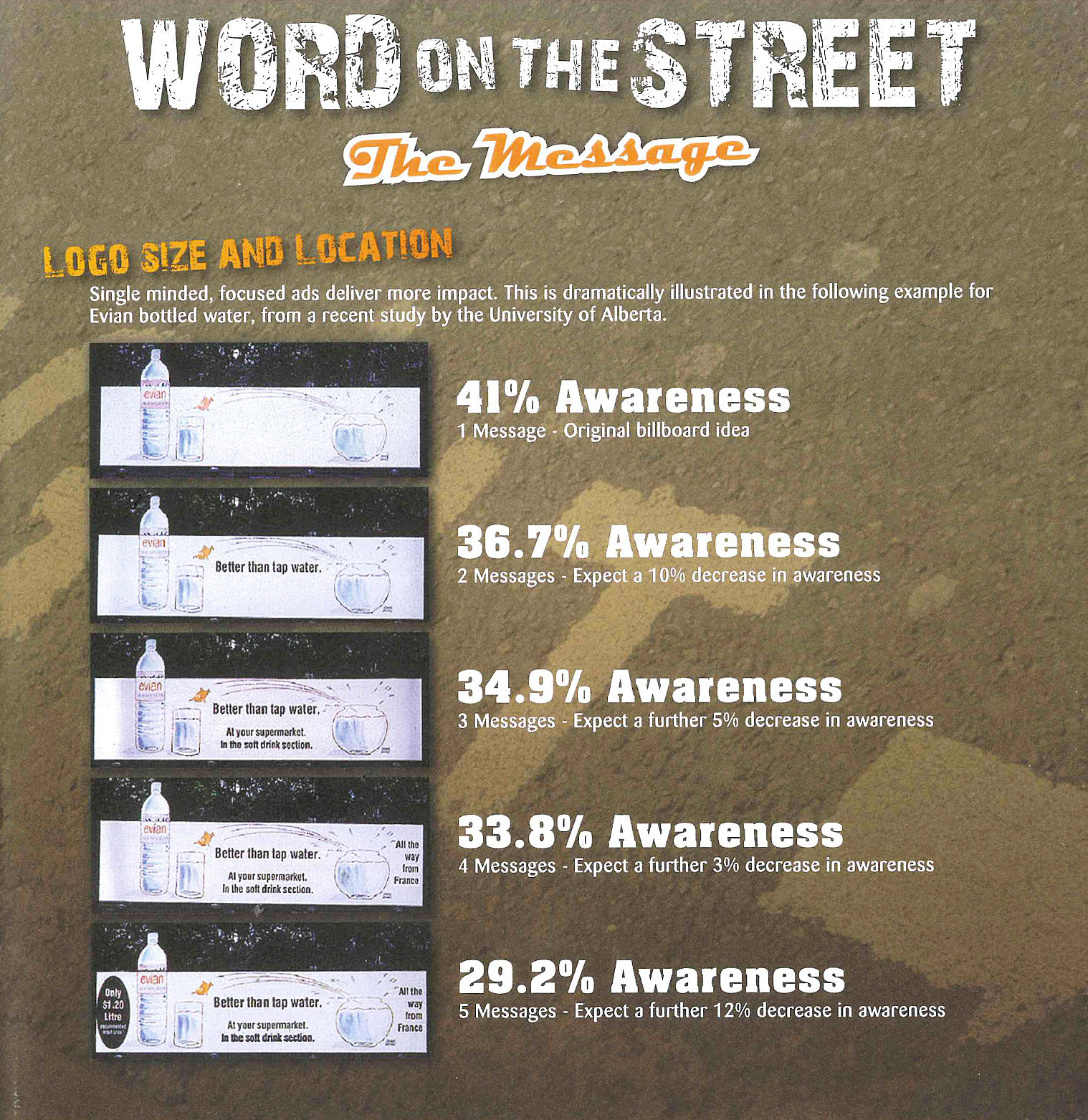
In ads, less is always more

We all know what good ads do: they say one thing, and they say it well.

Yet, many advertisers, in a bid to get the most bang for their buck, often try and fit as much into an ad as they can.

We all know it dilutes the message, and a few weeks ago a colleague passed on some research to support this…

DUSTIN LANE
Brand Strategy | Advertising Concepts | Copywriting

Visit risinggiants.co or dustinlanecreative.com

#fail: Most marketers and their use of social media

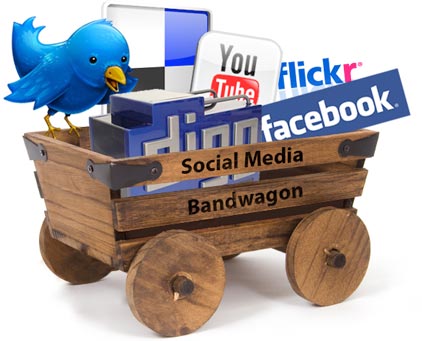
It still amazes me how many marketers just don’t understand social media. Many only see the word ‘media’ without taking any notice of the word before it – ‘social’.

After all, marketers should feel like they know about media. They have a long relationship with it. Or as one of my uni lecturers once put it, ‘Most media exists solely for the purpose of delivering an audience to marketers’.

But, ‘social’ media? No, it’s a different beast altogether.

The dictionary defines ‘social’ as:

1. pertaining to, devoted to, or characterized by friendly companionship or relations: a social club.

2. seeking or enjoying the companionship of others; friendly; sociable; gregarious.

3. of, pertaining to, connected with, or suited to polite or fashionable society: a social event.

So in general terms, social media is about people mixing, being friendly, having fun. If you’re a brand and you’re not doing this, well, you have no business being there.

It’s painfully obvious if you’re just trying to sell something and turn a quick dollar. And while other mediums might have grown up in an era where the interruption model of advertising reigned, social media didn’t.

This means people won’t accept being interrupted by commercial messages the way they have been in the past (actually, with the advent of things like TiVo and Time Shifting, you could argue that interruptive advertising’s best days are long gone).

Sure, other people may have a conversation about your brand using social media, but when you do it yourself, it just doesn’t work. And here’s the reason why: when you’re trying to apply some kind of sales message in social media, more often than not, you end up sounding like that ‘mate’ you only ever hear from when he wants a hand moving heavy furniture. He never rings you just to share a joke, or to catch up over a beer. In fact, the only time you ever hear from him is when he wants something.

Is that the kind of relationship you want your brand to have with its customers?

DUSTIN LANE
Brand Strategy | Advertising Concepts | Copywriting

Visit risinggiants.co or dustinlanecreative.com

Is your smart phone making you dumb?

Okay, let me start by saying that I might be the only person working in advertising who is yet to surrender to the iPhone phenomenon. Looking around the office and the hardware that people sit on the tables at meetings, these gadgets are everywhere. And it seems those few who aren’t in bed with Steve Jobs have an Android version.

On a daily basis, I listen to people talk about how much fun they have with the latest app they’ve downloaded. Wherever they are in the office, they receive the all-staff email about the leftover, free muffins in the kitchen. When any dispute or question arises, they pull out their trusty gadget and have the answer within a few taps. They’re probably the kings of Trivia Night at their local pubs.
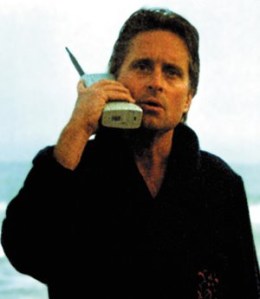
But not me. Why? Why do I resist this temptation and put up with jibes like ‘Hey, nice Motorola V3. Is that similar to the one Gordon Gecko had in Wall Street?’

Well, firstly I just don’t think the iPhone works as a phone that well – at least not yet, anyway. All the other functions seem to work fine, but try and call somebody to actually speak with them, and all bets are off.

But my laggard ways to adopt a smart phone run deeper. I actually suspect that these devices may be removing people’s ability to think – much like calculators have replaced my Art Director’s ability to do long division.

Think about it (no pun intended). These days we’re conditioning a society where you don’t actually have to know anything apart from how to open a browser and do a search. You don’t even have to know how to spell what it is you’re searching for – the search engine will understand what you mean and make any necessary adjustments.

If you don’t believe me, simply try it for yourself. I just Googled “how to cross a raod” (sic) and 361,000,000 answers were delivered to me in 0.15 of a second. That’s even faster than Usain Bolt could cross the road (providing he had Googled it earlier).

In this age of immediate access to information, we’re also breeding impatience. Once upon a time if you wanted to know the answer to something, you dragged your arse to the library and looked it up. These days, if our Internet connection is a bit slow and takes, heaven forbid, 5 seconds to deliver our 361 million answers, there’s usually swearing involved.

Look, I don’t want to give you the wrong idea. I’m not the main character from The Mosquito Coast. I’m not against the Internet and all the information it makes accessible. It’s great. I just think we have to be conscious of being plugged into all that information constantly. There are plenty of benefits to carrying a smart phone, but you should also consider the cost (and no, I’m not talking about when you exceed the data allowance on your cap plan).

Even good things need balance. Take water – it’s essential for life, but have enough of it, and it can kill you.

So, along with our newfound fondness of instant gratification (lack of patience), let me ask you this: when’s the last time you looked out the bus window and just pondered? Or sat in a park or shopping centre and just watched all the people pass by? When’s the last time you simply sat down and thought about a problem to arrive at your own solution, rather than looking up someone else’s?

The truth is that you need downtime. You need the freedom to think. So unplug yourself, at least for a little while each day, because your dreams and ideas will never happen unless you give them an environment to live in.

And if you still don’t believe me, well, look up ‘Daydream’ on Wikipedia.

DUSTIN LANE
Brand Strategy | Advertising Concepts | Copywriting

Visit risinggiants.co or dustinlanecreative.com

Always ask ‘why?’

Last week a colleague left the agency to travel overseas. She was a very good Account Manager and has a very bright future ahead.

She had come to the ad agency as a university graduate three years ago and this had been her first advertising job. As part of the graduate induction program, she started her career here by spending a couple of weeks in each department to learn how an agency worked.

In her two weeks sitting in the Creative Department alongside my Art Director and I, we offered her lots of tips and advice, but this I consider amongst the most important: Always ask ‘why?’

It seems simple but often this small question is overlooked. It’s imperative that you know the reason why you’re doing something. Not only does it make you aware of any other agendas that are at play, it helps your understanding and makes sure the solution provided actually fits the problem.

If you’re simply relaying a message from the client (or anybody else), you are effectively reducing your role to that of an expensive answering machine.

Put simply, if you’re unaware of the motive, don’t carry out the action.  Doing so just makes you look like one of these monkeys.

DUSTIN LANE
Brand Strategy | Advertising Concepts | Copywriting

Visit risinggiants.co or dustinlanecreative.com
Loading up the camel

A couple of years ago, we were working on a particular brand. It was quite an established player in other markets around the globe but was yet to make any real impact in Australia.

At one stage, the local client had his overseas colleagues visiting. These were people who were in charge of the brand in places like France and Japan. Anyway, the local client took the opportunity to bring his colleagues into the advertising agency to show them around and see how things were going.

After a bit of an office tour, everyone took a seat in the boardroom. Of course, the agency took the opportunity to show their wares by showing their reel and case studies of the great work they had produced for a range of different clients. Then, the client from Japan asked a very good question: ‘Okay, these are great examples of when your advertising has worked. What is the problem when it doesn’t work?’

Warren Brown, co-founder and Executive Creative Director of BMF, gave this great response:

‘Usually, when a campaign doesn’t work, it’s because there’s been a loss of focus. You move away from your single, clear objective. For example, let’s just say that the objective is to get from one side of a desert to the other. So, to meet that objective, we get ourselves a camel that’s perfect for the trip. The camel’s been trained to make that distance and he’ll do that particular job very well. But then, what often happens, is we start giving the camel other jobs to do as well. We give him extra things to carry, we change his route, etc. So while we started with a clear objective (to cross the desert) and had a fitting solution (a camel to do it), we lost focus and altered the objective. So, now that the camel has to carry extra weight and travel a different route, chances are he’s not going to make it.’

In marketing, we see this all the time. Ad agencies are often asked to alter a solution so it includes extra messaging, or appeals to extra target markets, or can be used in different media channels, or do something else entirely.

By doing this, you’re slowing down the camel so he won’t be able to meet the original objective. But worse still, in many cases you’ll even break his back.

Someone else has created this humorous video to highlight the problem…

DUSTIN LANE
Brand Strategy | Advertising Concepts | Copywriting

Visit risinggiants.co or dustinlanecreative.com