Tag Archives: advertising

Talk has always been cheap. But now it’s even cheaper.

It seems that almost every day, I hear stories or read articles about how the digital world is killing various businesses. However, in my opinion, it’s not the digital age that is causing grief for many organisations. It’s actually their inability to be authentic.

In marketing, there once was a methodology that if you told people your message enough times, they’d ultimately believe it (or as some would say, ‘throw enough shit, and some of it will stick’).

But, as we all know, mass communication is no longer the sole domain of commercial media channels. Anyone with a Twitter account, or access to an online forum can reach a large audience. That means that brands can’t rely on simply talking a good game, they now  have to actually play a good game.
Or, as one marketing quote puts it, “A brand is no longer what we tell the consumer it is. It’s what consumers tell each other it is.”

But the most successful brands have always set out to ‘do’ rather than ‘say’.
After all, a good comedian doesn’t tell you he’s funny. He simply is funny.
Good brands live their values. They don’t just put them together in a Powerpoint presentation and then subscribe to the ‘throw enough shit’ model.

And ads are simply an extension of this. It’s ads that ‘do’ rather the ‘say’ that are the most powerful. For example:

Apple, with their grammatically-challenged line, actually were different.
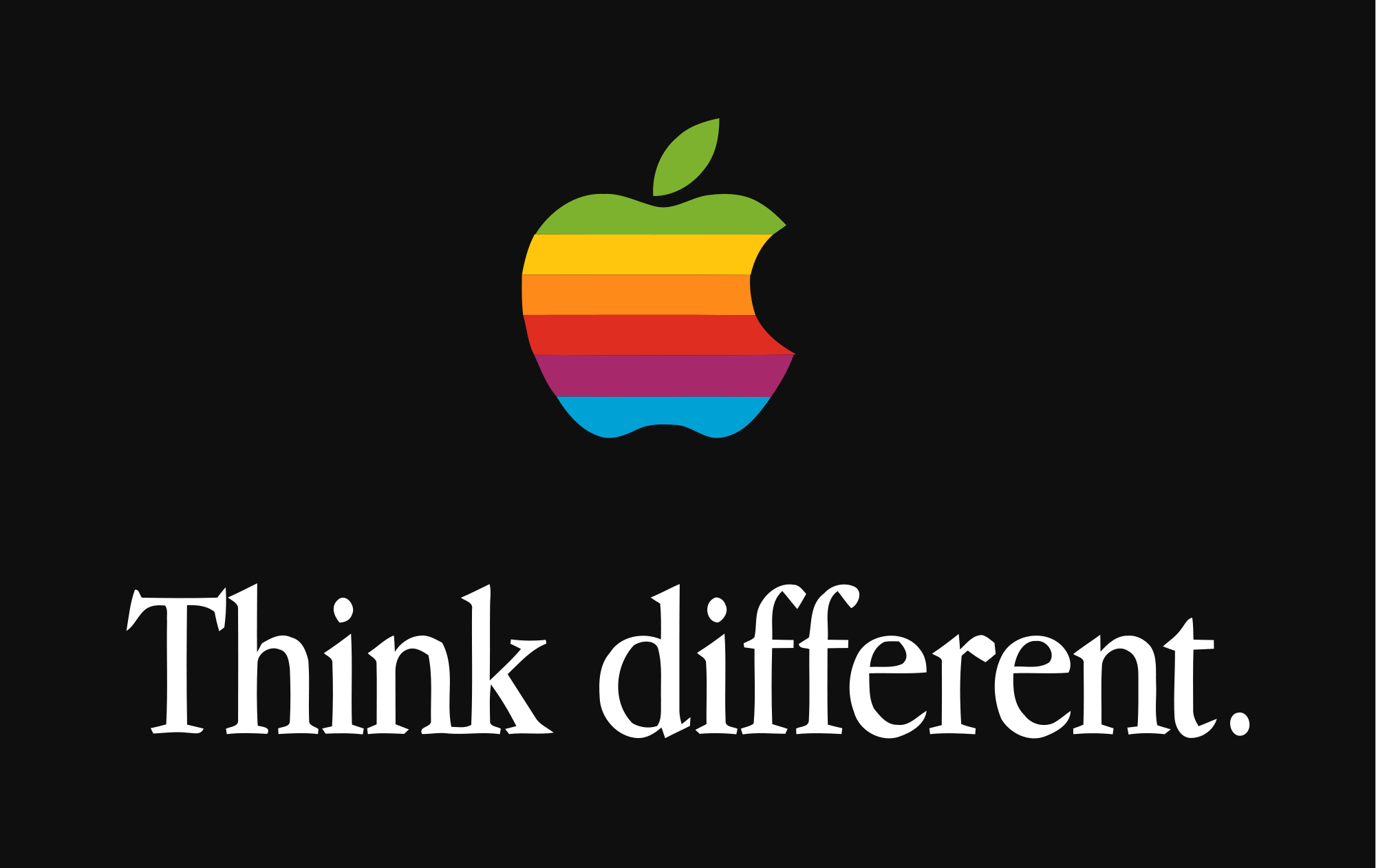
Apple_logo_Think_Different_vectorized.svg


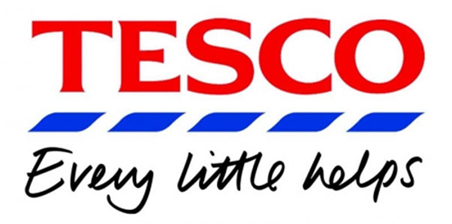
Likewise, Tesco didn’t talk about making cuts. With it’s tagline, they did.
tesco.jpg


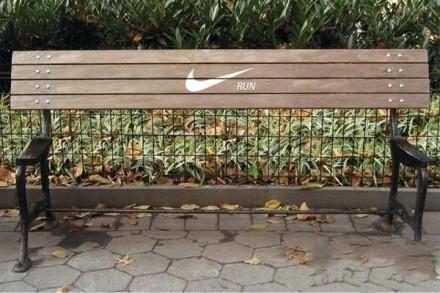
Nike doesn’t just talk about getting out there and doing it.
nike bench


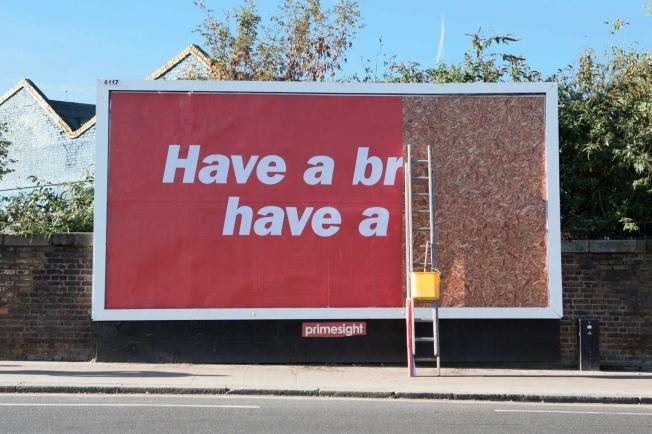
And Kit Kat doesn’t just lecture people to take a break. They take one themselves.
kit kat


It’s when you  say you do one thing, and you actually do another, that brands run into trouble. The digital age has merely exposed it.

DUSTIN LANE
Brand Strategy | Advertising Concepts | Copywriting

Visit risinggiants.co or dustinlanecreative.com

What’s your day rate?

Poor quality, low priceIf you’ve ever spent any time as a freelancer recently, you’ll be familiar with this question. It’s usually the first one asked. I guess it’s quite reflective of the commoditised market we now live in.

Rather than any number of other fitting questions, like: ‘Do you have experience with <insert target market>?’ or ‘Do you have experience with <insert brand category>?’ or ‘Do you have experience with <insert media channel>?’ or ‘Can I see your portfolio?’, the very first question is cost. And many people see cost and value as the same thing. They’re not.

However, the bigger problem here is the whole ‘time for money’ conundrum. Are we really selling ‘time’? If so, where can I buy some? (as I never seem to have enough of it)
I thought we were selling solutions – creative answers to communication or business problems.
That said, we’ve never really worked out how to charge for that. The value of an idea is so subjective. But is it any more subjective than the value of someone’s time?

I was once at an agency and heard the traffic person negotiating over the phone with a freelancer. He was looking at it through the wrong lens.
In his negotiations, I could see him quickly doing the calculations:

day rate
X
5 days per week
X
52 weeks per year
=
Wrong, wrong, wrong.

Even if you were working on that very ill-fitting equation, he needed to consider the following:
annual leave (take 20 days off in Australia)
public holidays (take another 10 days off in Australia)
sick days (another 10 days of allowance in Australia)
time spent invoicing and doing book work (all non bill-able)
superannuation contributions (this is actually a grey area that the Australian Tax Office is trying to tighten up)
down-time (no freelancer is booked 100% of the time. Sometimes the time between paying jobs can be considerable)

However, going back to the original question, what was the traffic person really buying? What was the value of the idea or piece of work they required?

A friend was recently contacted by a prospective client who said they didn’t have a very big budget and could only afford to pay $X per day. I asked him, ‘how does she know how long it will take you?’ My friend responded with the proposal of a project fee.

Another thing some agencies try and use as a bargaining chip is GST (Goods & Services Tax – you English readers will know it as VAT). In Australia, you must register for GST if you run a business or enterprise and your turnover is $75,000 or more ($150,000 or more for non-profit organisations).

In laymen’s terms, you simply add 10% to your invoice amount. You collect that on behalf of the tax office and pay it to them quarterly. Then, provided the client was a GST-registered business, they simply claim it back.

However, some clients try and use it as a bargaining tool, as if it’s actually costing them something. It isn’t. They claim it back. Don’t let them include the GST within your fee – it’s kept strictly separate.

When did the industry become about ensuring nobody else actually turns a profit? Was it the rise of the procurement department that gave birth to this behaviour? Was it the death of media commissions? Who knows?
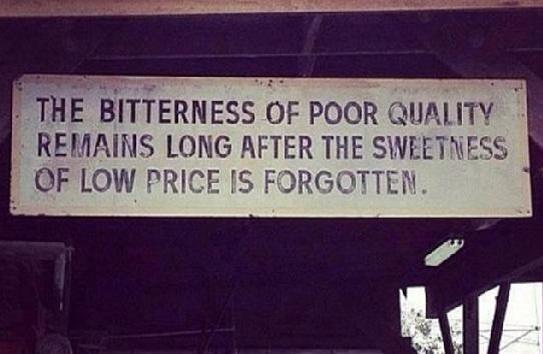
But putting all that aside, we just need to remember that, as with most things in life, you ultimately get what you pay for.

DUSTIN LANE
Brand Strategy | Advertising Concepts | Copywriting

Visit risinggiants.co or dustinlanecreative.com
Mark Twain was wrong. Shorter isn’t always better.

A famous Mark Twain quote goes like this: ‘I didn’t have time to write a short letter, so I wrote a long one instead’.
Plus, almost every advertising book ever written also extols the virtues of crafting copy so it’s short, sharp, and punchy. After all, less is more.

And while I agree, I’ll also say that it’s important to know when to bend the rules a little. Sometimes you’ll run into a client who has also read those same advertising books. They then go to work trimming back words with little regard to the overall effect on the tone of the ad. As a result, sometimes you find it’s definitely shorter but it’s also lost something. So, while ‘shorter’ is one way of making copy better, it’s  not synonymous with  making copy better.

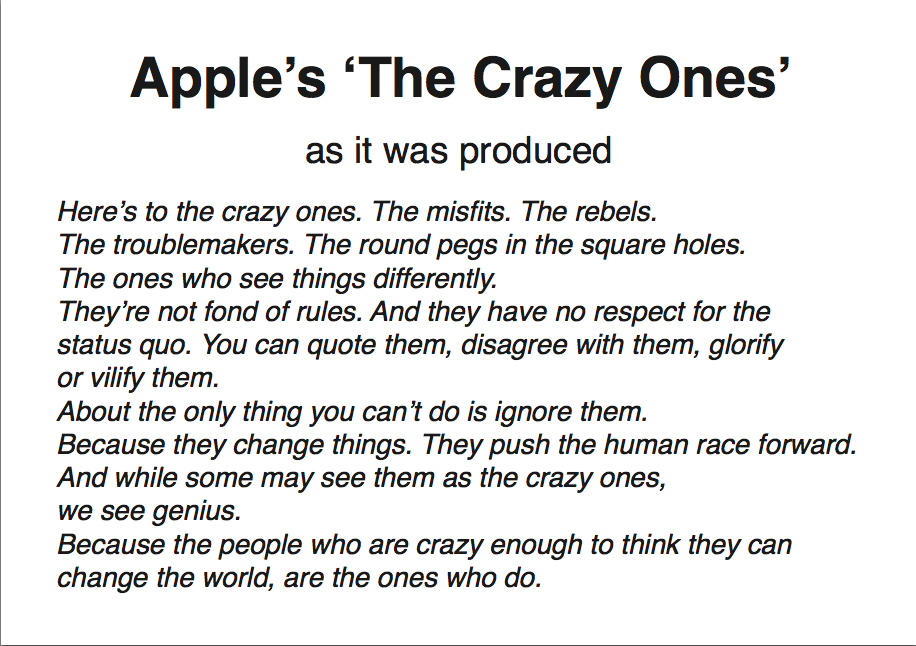
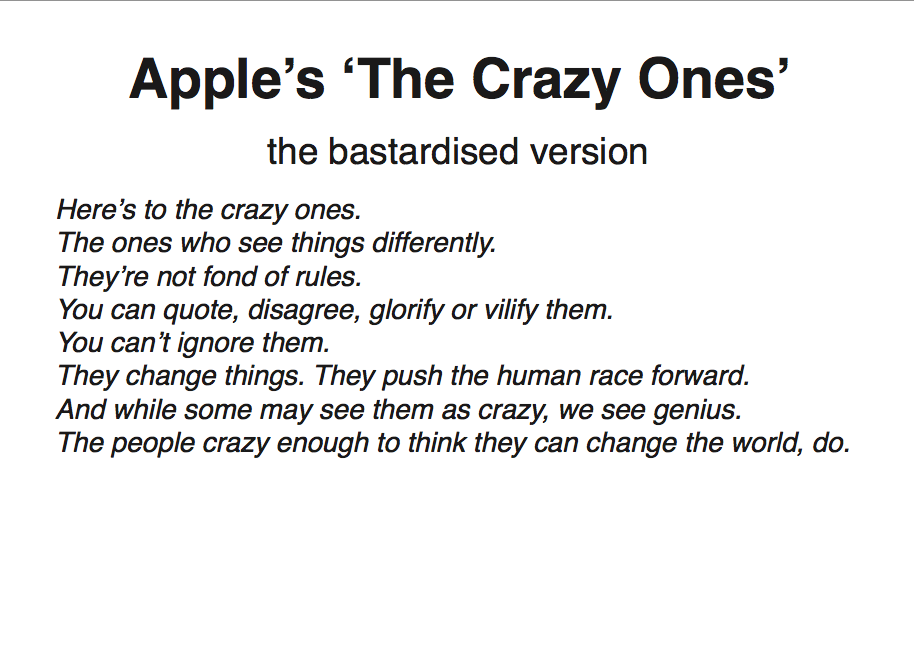
To illustrate this point, I’ve taken the script of one of my favourite ads (1997’s ‘Crazy Ones’ for Apple, by TBWA\Chiat\Day). I’ve then applied the ‘word economy’ rule and cut out the tautologies and other words someone might deem to be ‘superflous’.
Sure, you end up with shorter copy, but I wouldn’t say it’s better.
If you know the rules, you should also know when to break them (or, perhaps more relevant here, when to ‘think different’).

crazy ran

crazy strikethrough

crazy bastardised

Step back and take a look at yourself

If you work in advertising (or for that matter, any field that demands a lot of your time and energy) I strongly recommend you read this:

http://www.lindsredding.com/2012/03/11/a-overdue-lesson-in-perspective/

DUSTIN LANE
Brand Strategy | Advertising Concepts | Copywriting

Visit risinggiants.co or dustinlanecreative.com

Time poor = Attention poor

The other morning it was raining so unless I wanted to sit in wet clothes all day, it meant leaving the motorbike at home and catching public transport to work.

First, the bus. A lady sat next to me and, for the duration of the trip, furiously checked the emails on her Blackberry – no doubt trying to get up to speed so she could hit the ground running once she actually arrived at work.

Next, I was off the bus and boarded the train. In my carriage were two young ladies. Given their confined surroundings, they were having a reasonably loud conversation. It grabbed my attention because it turns out that one of them worked at another ad agency, across town. She was telling her friend how busy she was at the moment with one particular account, how she was working 14-hour days, and how the agency couldn’t afford to hire another Account Manager to help her out.

After the train, a short walk was all that was left between me and my place of work. However, just outside the station were two young people in purple t-shirts trying to hand out flyers for a nearby car-parking station. Like me, most people brushed past them in their hurry to get to work.

This small observation was where most advertising sits with people’s time-poor lives. The offer on those flyers could have been great. In fact, they could have been offering parking space for free, but because the message wasn’t delivered in a way that people were willing to accept it, it was lost.

People simply haven’t got time in today’s busy world. Just ask the lady reading her emails on the bus, or the train lady on her way to another 14-hour day. John Kane, founder of Happy Soldiers, used to tell his clients that their starting point was that people simply don’t care what the client has to say. And it’s true.

Years ago, Howard Gossage said that people read what interests them, and sometimes it’s an ad. Nothing’s changed. Put simply, it’s never an interruption if it’s interesting.

Back to those people handing the flyers out. What if you gave them a guitar and asked them to write some lyrics about how much better driving to work would be than using public transport? Surely, that would be better accepted than trying to shove flyers in people’s hands.

Look at the guy below. He had a pretty mundane message, but I’m sure people talked about it for days…

DUSTIN LANE
Brand Strategy | Advertising Concepts | Copywriting

Visit risinggiants.co or dustinlanecreative.com
Mark Fenske’s Nincompoop Forest

I recently came across a story that talked about Mark Fenske (at the time of writing, his site was offline) and his ‘Nincompoop Forest’.

Put simply, he talks about the importance of fighting for great ideas, and it goes like this:

For an idea to live, it must journey from the mind of its originator out into the ears of others, into the world.

To live, it must cross an area that is dangerous to the life of an idea… an area between the mind of an originator and the world where other people live who fight against ideas and try to kill them. This area, that challenges every ad idea the moment it is born, is called the Nincompoop Forest.

To find your way through the Nincompoop Forest, it takes heart, intelligence and determination.

There are many obstacles lying in wait. Some people fear big ideas, or are afraid to defend them, or don’t know how to explain or sell them.

Some people are afraid to buy big ideas because, by their nature, they have never been done before and can be scary. (It’s been said that if you’re not scared of an idea, it probably is not a big idea at all.)

You’ll have to save your idea from all the people who want to change the idea, “help” the idea, compromise the idea. They want to “make it better” or safer or less expensive or more comfortable.

All great ideas have to beware of the Nincompoop Forest.

DUSTIN LANE
Brand Strategy | Advertising Concepts | Copywriting

Visit risinggiants.co or dustinlanecreative.com

The power of music

At the moment, there’s a team seated a few desks over from me who are busy putting a TV ad together. They’re trying to decide on the music they’ll use (or create). Music should always be given the upmost consideration because it can make or break an ad. They don’t call it ‘the golden thread of film’ for nothing.

To illustrate this point to clients, I like to show them this ad from a few years back for Tourism Victoria…

Then, I show them the same ad, but where someone has put the music from Donnie Darko behind it…

I think you’ll see just how much of a role music plays in the mood and feeling of an ad.

DUSTIN LANE
Brand Strategy | Advertising Concepts | Copywriting

Visit risinggiants.co or dustinlanecreative.com
Information, entertainment and a beer with Daz

Recently I caught up with an old mate, Daz, for a beer.

Daz has an interest in a small business called Bark Blowers. Put simply, this service allows customers to have sand, soil, blue metal, pebbles or mulch installed without having to unload/reload on site. Through a powerful pneumatic hose system, you quite literally spray the product wherever you want it.

Recently, they’d done a commercial through a regional TV station. The station produced the ad for very little cost but he was unhappy with it. He said it was wall-to-wall voiceover and seemed like it just yelled ‘heaps of shit’ at the viewer. Knowing I worked in advertising, he asked my opinion on whether ads should be packed full of information, or whether having a strong element of entertainment was more important.

I answered that it’s an age-old topic discussed between advertisers (who tend to support ‘information’) and their agencies (who tend to support ‘entertainment’). Having worked for a regional TV station in a previous life, I also told him that they produced his ad so cheaply because their motive was to give him something he could run on air (where they make their money in air time).

I suggested that these are some things he might like to consider:

  1. Nobody turns on their TV to be yelled at (or even sold to, for that matter).
  2. Information-rich may be received favourably by those viewers who, at the very time of the ad going to air, are in the market for the services of his product.
  3. On the other hand, taking the ‘entertainment’ route  will give your message a longer shelf life, provided it’s done well. This is because good ads get noticed by more people. So, besides getting noticed by those who are currently in the market, the entertainment factor also often appeals to those who are not in the market at that particular time. However, there’s a good chance they’ll recall it in the future if they need that service.
So, in this way, the ‘entertainment’ route gives you more bang for your buck, provided the entertainment part of your ad is relevant. 
However, this  chat with Daz over a beer also highlights another of the challenges facing Adland at the moment – namely, the longevity of an ad or campaign, and how to get the most value from it.
This topic is discussed here, where a few of the readers’ comments suggest the way marketers should rethink their communication strategies.
Similarly, Nick Law from R/GA talks about this subject in a video filmed in 2009.
It might seem that in a ‘throw away’ world, we’ve even made the advertising too disposable.

DUSTIN LANE
Brand Strategy | Advertising Concepts | Copywriting

Visit risinggiants.co or dustinlanecreative.com

ADMA Forum 2011

I was asked to give a talk at the ADMA (Australian Direct Marketing Association) Forum last week – a simple ten-minute presentation showing an interesting example where an organisation has used mail as part of their marketing communications.

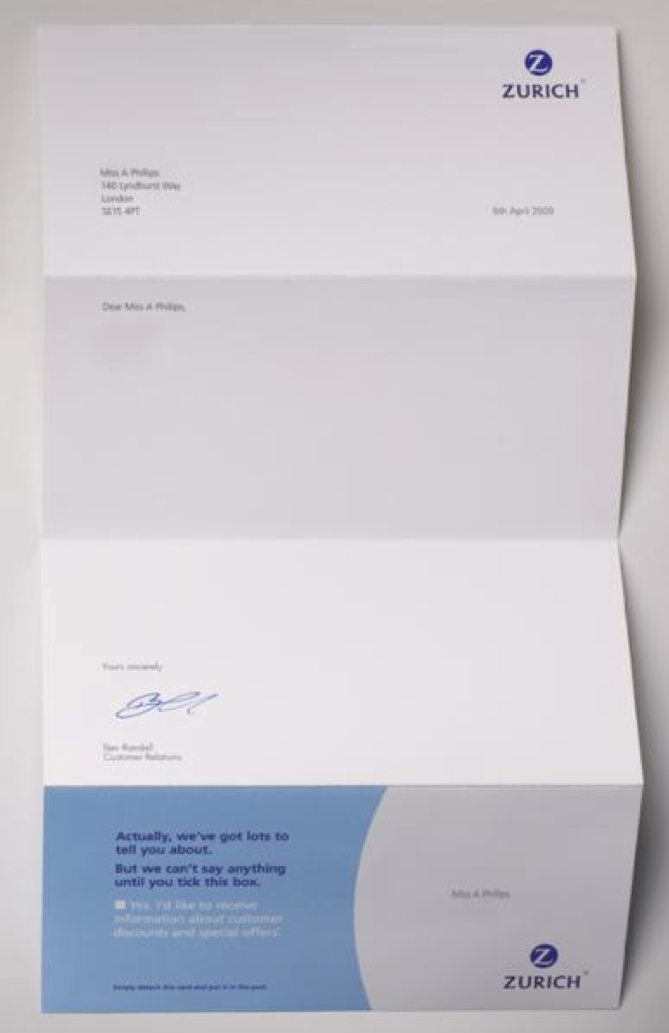
I could’ve found a big, dimensional mail pack with lots of wow-factor but, let’s face it, not many marketers have the budget to do those. So I looked for a nice, simple example of a letter and envelope. And I came across this one from Zurich Insurance, produced by Publicis Dialogue in London (source: Directory, directnewideas.com).

The copy says:

Dear Miss Philips,

Yours sincerely,

<Customer Relations Guy’s name>

Actually, we’ve got lots to tell you about. But we can’t say anything until you tick this box.

Yes, I’d like to receive information about special offers.

According to the case study, the problem was that 25% of Zurich customers had opted out of receiving marketing communications. This letter convinced 7% of recipients to change their mind and opt back in. A pretty good result.

‘Opting out’ is pretty bad news for marketers, because it’s the customer saying, ‘I don’t want to hear from you anymore’. It’s the end of the conversation, and if the customer ended it, it must not have been that good in the first place.

What many marketers don’t really want to acknowledge is that your starting point is this: People don’t care what you have to say.

As blunt as it sounds, it’s true. People are too time-poor and you’re just one of many  organisations yelling and selling at (potential) customers.

So, what’s the solution? Well, it’s pretty simple – don’t create ‘ads’. An ad is something people avoid. Rather than create ads that try and interrupt or invade people’s lives, create something people seek out and engage with. Now, many people might say, ‘People don’t actually seek out ads do they?’ Yes, they do. Provided they’re good and/or relevant enough.

Howard Gossage, muttered these words during the Madmen era, and they’re probably more relevant now than they’ve ever been:

“People read what interests them, and sometimes it’s an ad.”

For example, take a look at The Old Spice Response campaign.

20 million views in the first three days, 40 million in the first week. Website traffic up by 300%, and sales up by 107% – here is a case a people seriously ‘opting-in’ to a brand.

Now, I’m not suggesting we go and make personalised videos every time we want to talk to a customer but there are some important points we can take on board, whatever medium you use…

  1. Successful brands are not defined by a logo, a typeface and a colour palette. Successful brands are defined by what they do and how they do it.
  2. Successful brands push the boundaries. They don’t play by the rules, they rewrite them.
  3. Let your brand speak like a person (i.e ‘Dear <first name> <last name>, As a valued customer…’ is not speaking like a person).
  4. Provided you’re not delivering bad news, have some fun. Fun is infectious. It’s what people want to interact with. If you have fun making your communications, people will have fun watching, reading or listening to them.

DUSTIN LANE
Brand Strategy | Advertising Concepts | Copywriting

Visit risinggiants.co or dustinlanecreative.com