

Each morning, I have a coffee and look at the beach. There’s usually a lot of pondering involved. Sometimes, it’s deep pondering on the workings of the universe, and other times it’s more superficial, like ‘why isn’t the letter ‘w’ called ‘double v’ rather than ‘double u’? Or, wondering if Volvo drivers are secretly happy now that the world has Tesla drivers.
Anyway, this pondering changed direction when I saw a person walk past with their phone perched in a gimbal while they did a ‘walk and talk’ video. This prompted me to think about where advertising is at the moment, and where it’s headed.
In simple terms, you could say that advertising’s job IS perception. After all, it creates, manipulates, and manages how a product is perceived.
But what about the ad industry itself – how is it perceived?
Apparently, size does matter.
It seems advertising used to be a bigger deal.
Big, mass media.
Big ideas.
Big productions.
Big budgets.
Big salaries.
Everyone knew it, from banks to breweries.
But then, things got smaller.
Media splintered, and catered to smaller audiences.
Screens got smaller.
Timelines got smaller.
And budgets and salaries followed.
Perception plays a role here.
If the screen is smaller, and the audience is a single person rather than multiple people gathered to view a single screen, it’s no longer perceived as ‘big’. The grandeur is gone.
In the ad industry, when the internet first started making inroads, we all became familiar with a client’s production budget shrinking to reflect the media in which the ad would be shown. Many clients expected the production of a 30-second film to be much cheaper if it was ‘only going online’.
Can you imagine what a car dealer would tell you if you went into a showroom and wanted to buy a car for a cheaper price and offered the rationale that you’d only be driving it on particular roads?
When cost-cutting kills more than your costs.
Most people would be familiar with the old triangle of values: ‘Quality, Time, Cost – have any two’. It’s based on the premise of two values coming at the detriment of the third (i.e. you can have the work done well and quickly, but it won’t be cheap OR you can have the work done well and cheaper, but it’ll take time OR you can have the work done cheaply and quickly, but it won’t be good).
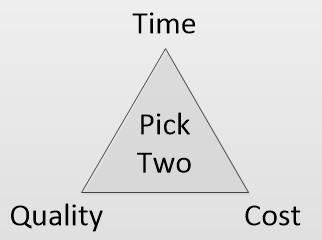
(I was always of the opinion that quality wasn’t expendable, so one of the other two values had to be sacrificed. Not all marketers agree.)
Then, along came generative A.I.
And, with it, the promise that you can have all three values.
Now, whether it currently delivers on quality is up for debate. Problems with image continuity, anatomy, and receiving what you actually requested is still an issue. But we all know the tech will eventually get there.
So, what then?
Well, that’s when perception might really come into play.
Right now, it’s being over-looked, either unconsciously or otherwise.
Perception doesn’t appear on a spreadsheet.
When people know that something has taken effort, they assign a higher value to it.
It’s why people get their photo taken in front of the Sydney Opera House.
It’s why people appreciate a beautifully prepared meal.
And, it’s why brands put the words ‘hand-made’ on labels.
However, when we get to that stage where people will know, or assume, that someone has simply punched in a few prompts to create something, that same value is unlikely to be assigned.
Instead, the output becomes highly disposable.
The inference by the viewer/reader/listener is ‘that business has not bothered to invest in their message, so why should I invest my time in it?’
Of course, consumer psychology like this doesn’t show up on a marketing spreadsheet, but it’s something that needs to be considered.
After all, once everyone has seen behind the curtain and knows how the magician does his tricks, the magic itself disappears.
DUSTIN LANE
Brand Strategy | Creative Concepts | Copywriting
Visit risinggiants.co or dustinlanecreative.com


 dingosbreakfast.com