
Category Archives: Uncategorized

Why do clients pick one ad agency over another?

A lot of marketing dollars from around the world ride on this question. Well, I reckon there are five basic reasons that influence a client’s decision. Each of them play a factor, but every client is different in the  level of importance they allocate to each.

1. Relationship

You see this time and time again, when a marketer moves companies and soon hires an agency they previously worked with. And that’s fair enough. If you have a good relationship with someone that’s tried and trusted then why not go with it?

Also falling into this category is the client that is just looking for a buddy – someone they can call anytime and have a chat with, or someone they can hit the golf fairway with, eat at fancy restaurants with, etc.

2. The Work

By ‘work’, I mean the ideas and the end product that appears on our TV screens, billboards, magazine pages, etc. The purists in agency-land would love to believe that if you get this right, it’s all that matters. And in an ideal world, that would be the truth. ‘Best work wins’, right? Unfortunately, this isn’t always the case.

3. Cost

There’s always an agency willing to do it cheaper. And in recent times, this trend is pushing ad agencies into a position that simply isn’t sustainable. Plus, the work ultimately suffers because lower margins means you can’t afford to have the best people working for you (or giving the time required). There are no winners in a numbers game, only casualties.

4. Resource suitability

Some agencies are organised to fulfil specific needs. A client might want an agency with expertise or processes that suit a particular type of advertising (retail specialists, digital specialists, promotion specialists, fast turn-around stuff,etc).

5. Obedience

Marketers choose this type of agency because it makes them feel powerful, or they feel safe knowing they’ll get pretty much exactly what they ask for, when they ask for it. There is often no room for exploring new options, or unconventional approaches. In many ways, the agency’s role is reduced to that of a  studio. They cease to be partners in solving business and/or communication problems. Their role is simply one of servitude. In this position, creative people’s passion is often snuffed out.

So, if you’re a marketer, where do you place the weight of your criteria? Or if you’re an agency, which ones are your priority? It’s only when the agency and marketer are on the same page that a healthy marriage happens.

DUSTIN LANE
Brand Strategy | Advertising Concepts | Copywriting

Visit risinggiants.co or dustinlanecreative.com

‘Imagine’, a book to add to my reading list

And here’s someone’s 2-minute review:

DUSTIN LANE
Brand Strategy | Advertising Concepts | Copywriting

Visit risinggiants.co or dustinlanecreative.com
Words of wisdom

Whether the outcome of a situation is positive, negative, or neutral, I believe there is always a lesson to be learned in everything we do in life. Sometimes, we simply don’t look for it. And, while I believe in learning from my mistakes, I think it’s even better if I can learn from the mistakes of others.

So about two and half years ago, I began meeting with highly successful people in the advertising industry from around the world. So far they have ranged from Executive Creative Directors, Chief Executive Officers, people who are (or have been) on the Board at large multi-nationals, people who have built their own agencies, people who have been nominated into advertising ‘hall of fames’, and so forth.

Put simply, I just wanted to pick their brains and ask them about their experiences and what they’d do differently if they had the opportunity. So after many chats over coffees, beers and even Skype, here are just a few words of wisdom from those who have been there…

“The biggest realisation that you make is that it’s relatively easy to make the same salary on your own as you do when you’re employed by an agency.”

“Just make the work brilliant. If the work’s consistently good, it’s what gets you on lists, it’s what gets noticed, it’s makes the place fun to work at.”

“As you grow and get more people around you, you feel safer.”

“None of us had much business nous. We didn’t have a solid business model or anything to begin with – it just kind of evolved as we went. The only thing we did know was the kind of work we wanted to be doing and the kind of work we didn’t. You just have to jump in and do it. You learn so much from actually doing it.”

“You need to devote yourself to new business, and make it an ongoing thing. You can get caught in the trap of just servicing existing clients, and when one of them walks, you’re left living hand-to-mouth for six months until you can win something else.”

“Learn about business. Understand how it works, and how they make money. Once you understand business, you have remarkably different conversations with clients. They no longer treat you as the ‘weird creative people’ who just make funny ads (that makes them a bit nervous). If you illustrate an understanding of their business, they treat you differently.”

“It’s better for business if you fire a bad client rather than keep them.”

“As a creative, you’re a problem-solver. If you can keep that in mind, and run a business as one that solves a client’s problems, there really is no difference between being a ‘suit’ and being a ‘creative’. But avoid becoming a ‘client’s studio’ – there is not a lot of long-term value in that.”

“It’s easier to run a business on a retainer because you know what’s coming in and you can staff up accordingly. Also, it’s psychologically easier for a client to pay $10k per month rather than sign a cheque for $120k at the end of the year, even though they’re the same amount.”

“Lease everything. And if you get a place, put all your money into the boardroom. Make it big and make it good.”

“There are enough ‘good’ clients around. It is a balancing act, but if a client is not aligned with you, get rid of them.”

“At the time, I enjoyed the comfort of selling half my business to a holding company, but now I see little value in continuing to give them half the profits of all my hard work.”

“Regardless of the scope of our ideas, I found that unless we actually called ourselves an ‘ad agency’, clients didn’t really know how to deal with us, or which pigeon hole to put us in.”

“For some people, ‘freedom’ is having a place with their name on the door. For me, ‘freedom’ is not having my name on the door and knowing I can walk away tomorrow if I choose to.”

“Decide early on if you’re building a business to sell or a business to allow you to do the kind of work you want to do. That decision will play an important role in some of the choices you have to make down the track.”

“Stay true to the reasons why you started.”


DUSTIN LANE
Brand Strategy | Advertising Concepts | Copywriting

Visit risinggiants.co or dustinlanecreative.com

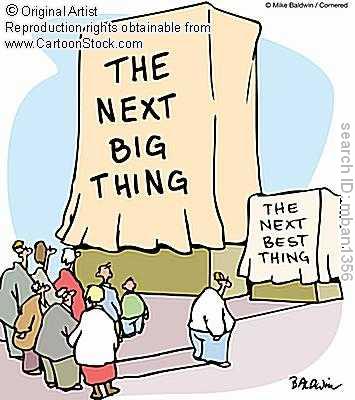
Are you brave enough for ‘the next big thing’?

If you work in advertising, you’ve probably sat in one of those meetings where the client has said that they want a <insert the latest big advertising success here>.

In recent times, this comment has taken the form of ‘We want a Share a Coke’.

Before that, it was ‘We want an Old Spice Guy’.

And before that, it was ‘We want a Best Job’.

I’m sure you get the idea.

However, it reminds me of a friend’s old tweet, which read ‘Most clients want a big, original idea – and three examples of where that idea has worked before’.

This, of course, is a paradox. If something has been done before, it’s not original. And advertising is a business where originality is rewarded with a customer’s interest and engagement.

The truth is, the campaigns mentioned here are the product of great ideas that simply would not have existed without the belief and bravery of the marketers behind them.

For a moment, let’s pretend that none of the ideas above had been done.

With the Coke idea, you’re choosing to make the product brand name considerably smaller and/or replace it with the name of customers. Then there are the logistics of actually printing the new packaging and getting it to market via numerous supply channels.

With the Old Spice Response campaign, the idea is to create on-the-run pieces of film that are each aimed solely at one individual. So in essence, multiple TV ads without media spend, approvals or buttoned-down pre-production meetings, that are aimed at an audience of one.

And with the Best Job In The World, where glossy pictures are the category norm, you’re looking at reducing your ad to the classifieds.

Now, how many marketers can put their hand on their heart and say, ‘Yep, I would buy that’.

There are plenty of things that make these ideas either too hard or too risky. But they say fortune favours the brave. Or, as General Patton said, ‘Courage is fear holding on a minute longer’.

DUSTIN LANE
Brand Strategy | Advertising Concepts | Copywriting

Visit risinggiants.co or dustinlanecreative.com

Give your target audience more than a sales message

Today, I left the office to buy an attachment I needed for my computer. On my walk to the shop, I came across the scene shown in the video below. It reminded me of a few important things some marketers seem to forget when they’re trying to engage an audience.

Of these, the most important thing is that ads are rarely invited into people’s lives. They’re usually unwelcome guests that interrupt your favourite TV shows, barge their way onto the pages of your magazines, and invade your websites and mailboxes. But not the smart ads.

For example, how many times have you walked past people handing out flyers advertising city parking without giving it another thought? Well, that didn’t happen here. Myself and plenty of others watched this guy for quite a while.  And the main thing is, a smile wasn’t all we walked away with  – we walked away knowing where we could get monthly parking for 300 bucks.

DUSTIN LANE
Brand Strategy | Advertising Concepts | Copywriting

Visit risinggiants.co or dustinlanecreative.com

Ad agency remuneration: the chatter continues

Via Adage. Advertising legend Lee Clow weighs in on the debate.

(Click the adage link to read the story)

Youtube’s Kevin Alloca on why videos go viral

A short talk (via TED talks) on why some videos capture the attention of the world:

How do we get safer roads?

Recently, I saw an article posted on facebook. It was an open letter to drivers from a mother who, along with her family,  had suffered a great tragedy. It tells a very sad story of how her life was changed in an instant. It’s the type of story that stays with you for a while, and one that certainly encourages drivers to be more careful.

Now, over the years, there’s been some great ads asking people to drive more safely. Take this one for example:

Ads for safer driving have used shock, logic, ridicule and a range of other methods to try and achieve their objective. However, many lack the most important thing – timing. Ads are most effective at the point of decision, whether it’s standing in the supermarket aisle, or sitting behind the wheel of a car.

So, why haven’t we built this messaging in as a mandatory feature on vehicles that are registered for use on our roads? For example:

  • At the moment, some cars have little speed alerts that beep when you  exceed the speed limit. A ‘beep’ isn’t very emotional. What if we re-jigged this feature so a small transparent image of your loved ones projected onto the windscreen? That would add a reason why you shouldn’t be speeding rather than just telling you not to.
  • What if a car’s radio was fitted with a voice-recording that asked you to consider your family and the families of others? It could be triggered if you exceeded the speed limit.
  • What if mobile phones reminded you not to answer while you’re driving? Instead of ringing with your normal tone, the GPS sensor would detect that you were moving at a certain speed, so would simply announce that somebody is trying to call you, but it’s best not to answer it until you pull over.

Now, I know that the ultimate responsibility rests with the individual, but if we could provide a few more ways to help people drive safely (or barriers to stop them driving unsafely), it can only be a good thing.

DUSTIN LANE
Brand Strategy | Advertising Concepts | Copywriting

Visit risinggiants.co or dustinlanecreative.com
Which target market are you really making ads for?

The other day I was reading an article in BRW magazine. It listed the fastest growing companies in Australia for 2011. Placed at #2 was Jetts 24 Hour Fitness with 2010-11 revenue of almost $43m and more than 403% growth.

Put simply, Jetts is a chain of gyms that offer 24-hour access, basic equipment, and no contracts. In an industry dominated by full-service gyms such as Fitness First and Fernwood, this was an entirely new business model.

The Managing Director of Jetts, Brendon Levenson, says that the fundamental backbone of his business is that they simply listened to their customers and gave them what they wanted, even if that meant challenging conventional industry thinking.

This got me thinking about the advertising industry and our customers. The tricky thing is that an ad agency is in the position where the work it does actually has two target markets. Firstly, there’s the client (the one giving you the work and paying the bills), and secondly, there’s the end-customer (the one that’s buying the product or service and ultimately paying the client’s bills).

And here’s the problem: while a successful ad appeals to the end customer, it’s not always the same type of ad that will appeal to a marketing client. Some marketers find it hard to remove their own views or walk in the shoes of their consumers. Usually, they have a skewed version of their product, or how the market perceives it. And the greater the difference between the client’s view and their customers’ view, the worse the ad.

But surely this can be addressed with a fairly honest and open conversation with your client, can’t it? Well, that’s probably a question for you to answer next time you’re taking a brief or accepting feedback.

DUSTIN LANE
Brand Strategy | Advertising Concepts | Copywriting

Visit risinggiants.co or dustinlanecreative.com

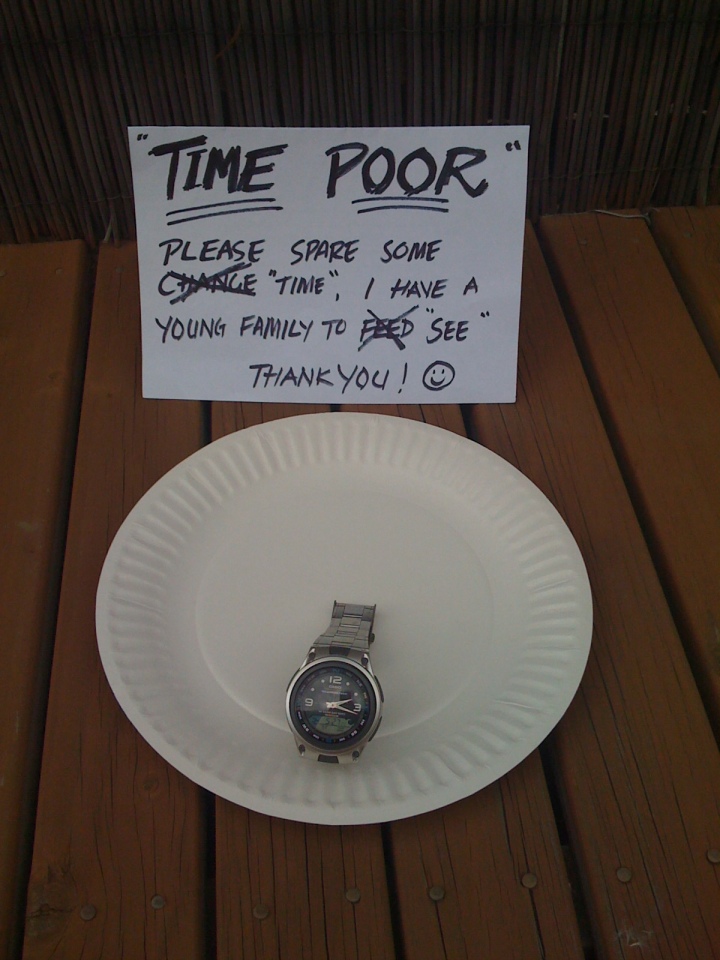
Time poor = Attention poor

The other morning it was raining so unless I wanted to sit in wet clothes all day, it meant leaving the motorbike at home and catching public transport to work.

First, the bus. A lady sat next to me and, for the duration of the trip, furiously checked the emails on her Blackberry – no doubt trying to get up to speed so she could hit the ground running once she actually arrived at work.

Next, I was off the bus and boarded the train. In my carriage were two young ladies. Given their confined surroundings, they were having a reasonably loud conversation. It grabbed my attention because it turns out that one of them worked at another ad agency, across town. She was telling her friend how busy she was at the moment with one particular account, how she was working 14-hour days, and how the agency couldn’t afford to hire another Account Manager to help her out.

After the train, a short walk was all that was left between me and my place of work. However, just outside the station were two young people in purple t-shirts trying to hand out flyers for a nearby car-parking station. Like me, most people brushed past them in their hurry to get to work.

This small observation was where most advertising sits with people’s time-poor lives. The offer on those flyers could have been great. In fact, they could have been offering parking space for free, but because the message wasn’t delivered in a way that people were willing to accept it, it was lost.

People simply haven’t got time in today’s busy world. Just ask the lady reading her emails on the bus, or the train lady on her way to another 14-hour day. John Kane, founder of Happy Soldiers, used to tell his clients that their starting point was that people simply don’t care what the client has to say. And it’s true.

Years ago, Howard Gossage said that people read what interests them, and sometimes it’s an ad. Nothing’s changed. Put simply, it’s never an interruption if it’s interesting.

Back to those people handing the flyers out. What if you gave them a guitar and asked them to write some lyrics about how much better driving to work would be than using public transport? Surely, that would be better accepted than trying to shove flyers in people’s hands.

Look at the guy below. He had a pretty mundane message, but I’m sure people talked about it for days…

DUSTIN LANE
Brand Strategy | Advertising Concepts | Copywriting

Visit risinggiants.co or dustinlanecreative.com