Category Archives: Uncategorized

Mark Twain was wrong. Shorter isn’t always better.

A famous Mark Twain quote goes like this: ‘I didn’t have time to write a short letter, so I wrote a long one instead’.
Plus, almost every advertising book ever written also extols the virtues of crafting copy so it’s short, sharp, and punchy. After all, less is more.

And while I agree, I’ll also say that it’s important to know when to bend the rules a little. Sometimes you’ll run into a client who has also read those same advertising books. They then go to work trimming back words with little regard to the overall effect on the tone of the ad. As a result, sometimes you find it’s definitely shorter but it’s also lost something. So, while ‘shorter’ is one way of making copy better, it’s  not synonymous with  making copy better.

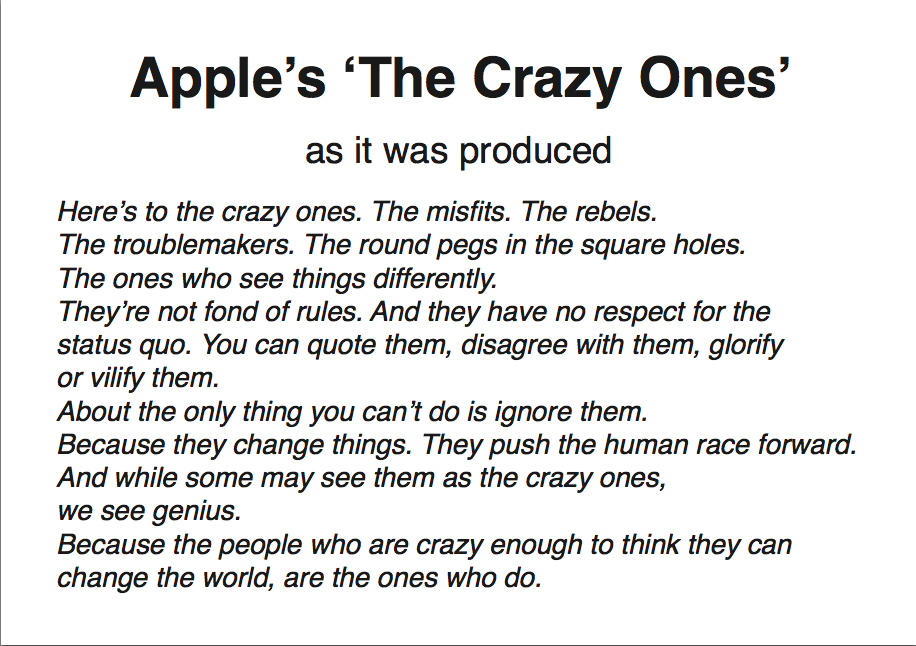
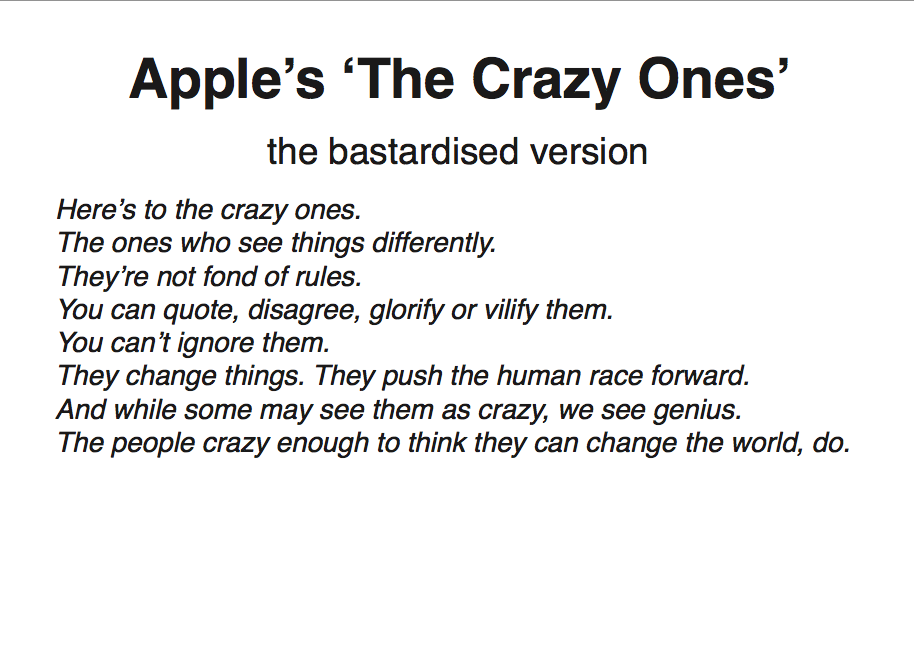
To illustrate this point, I’ve taken the script of one of my favourite ads (1997’s ‘Crazy Ones’ for Apple, by TBWA\Chiat\Day). I’ve then applied the ‘word economy’ rule and cut out the tautologies and other words someone might deem to be ‘superflous’.
Sure, you end up with shorter copy, but I wouldn’t say it’s better.
If you know the rules, you should also know when to break them (or, perhaps more relevant here, when to ‘think different’).

crazy ran

crazy strikethrough

crazy bastardised

5 thoughts on voice over artists

Microphone and cansI recently finished a job that required using a few voice over artists. I remember when I first started working in advertising how cool it must be to actually say that you’re a voice over artist. Imagine dropping that at a dinner party when people ask what you do. Or a world, in my mind at least, where girls suddenly listen harder to what you say when they find out you’re a VO (after all, if  other people pay money just to hear you speak, that voice must be nice to listen to, right?).

Not a lot is ever said about voice over artists. Usually, casting isn’t given enough time and/or consideration.  But I think it’s important. If you don’t agree, simply listen to the great Miller campaign directed by Errol Morris. First, listen to this ad. Then listen to this one, or this one, or this one. In my opinion, the second voice adds so much more to the spots. It helps create a great tone and personality for the brand.

So, here are 5 thoughts on voice overs:

1. Voice over artists should never sound like voice over artists.
Unless you’re doing an ad that takes the piss out of voice over artists, or a trailer for this Summer’s film blockbuster, your VO should never sound like the guy in the video below.
http://www.youtube.com/watch?v=fVDzuT0fXro

Honestly, in the real world, who talks like that? Except this guy.
Yet, casting for VO talent is hard. Usually, the only useful part on their demo reel is the bit at the start where they say, ‘Hi, my name is ……, and this is my demo reel’. After that, they launch into ‘the big voice’, so it can be hard to get a good grasp on what they really sound like. For that reason, I find actors are generally better than pure VO artists. Actors understand the character or role they’re playing and tend to speak rather than project their voices.

2. Talk the talent through your idea.
Don’t just hand them a script and ask them to step into the booth. Before that, talk them through your idea or script. Give them a bit of context so they can get a feel for the type of read you’re looking for.

3. You can tell early.
I reckon you can tell in the first 4 reads if you’ve cast the right person or not. People either get it or they don’t. Sometimes this isn’t the case and people can get it with a little more time but, generally speaking, they’ll be reasonably close to the mark early on. And that brings me to my next point.

4. Don’t burn the talent out.
Usually, when a voice over is freshest, you’ll get the best from them. The writer knows the way they want it read (the tone, where the emphasis and inclinations lie, the type of character etc). Get that down first. Then feel free to try some other stuff – good talent sometimes add things that can really improve your script.

5. Have a great sound engineer.
A great sound engineer brings so much to the table. They know their stuff, can make useful suggestions and, like good VO talent, make 30 seconds seem much longer when you need it to be.

What about you? What other tips would you offer regarding the use of a voice over artist?

DUSTIN LANE
Brand Strategy | Advertising Concepts | Copywriting

Visit risinggiants.co or dustinlanecreative.com

Is your big idea a one-off?

$27 car rentalHere’s a picture of a shop near my office. Three weeks ago it was a Lamborghini dealership. Now it’s a place that rents small cars for $27 a day. I reckon that might be a pretty good reflection of where things are at. It seems most successful business models now drive profit through volume rather than margin. And I’m relatively sure there are more people looking to rent a car for $27 a day rather than buy one for a lazy half million dollars.
Look at the businesses making all the money – supermarkets, Google, telcos, the list goes on. They all sell lots of product for a small margin rather than fewer products at a large margin (perhaps with the exception of Apple, who seem to be doing both margin and volume).

And that brings me to advertising agencies. Most advertising agencies deliver a very bespoke product. It’s an idea or advertising campaign designed to suit a particular client’s needs. Even if it can be used to carry another client’s message, it’s contractually obligated not to do so. This means all the work  you do in delivering a product (campaign or idea) amounts to one sale.
So rather than make one product and sell it thousands, perhaps millions, of times  we make one product and sell it once. (Actually, it’s lower than once when you consider the ideas and campaigns we work on that the client doesn’t buy.)

Then on top of this, you have other forces working against the ‘way it used to be’. The internet has conditioned us not to pay for stuff anymore. It’s given rise to the Fremium model, and things like Fiverr.
Sure, in most cases, you get what you pay for. But it seems people don’t like paying for the art of a Lamborghini when they think they can do the same with a car for $27.
So what about you and that big idea you’re working so hard on? Are you only going to sell it once?

DUSTIN LANE
Brand Strategy | Advertising Concepts | Copywriting

Visit risinggiants.co or dustinlanecreative.com
Are you getting in to advertising, or getting out?

Years ago, I was asked to give a talk to advertising students at a university.
Now, it seemed that every intern or grad primarily wants to know the answer to two questions: 1) How did you get your job?; and 2) What advice would you give to others?

So in preparation for my talk, I took the opportunity to ask a few colleagues around the department and filmed their responses. That way, the students at the lecture could hear other stories as well as mine.
This video is below (please excuse the transitions – it was 2006. I was young. iLife was in its infancy).

I once heard the story of a young creative being told, ‘You’ll be underpaid in the first half of your career, and overpaid in the second half of it’. Well, I’m not sure the back half of that sentence still applies in today’s world. The profit margins simply aren’t there anymore.

But recently I came across another video, below. It’s not about getting in to advertising. Instead, it’s about using advertising as a stepping stone towards something else. Spending time in the advertising industry provides you with some great skills – you get to think outside the box, you get to challenge conventions, you see behind the curtain of lots of different industries.

One of the best books I’ve read over the past few years is Seth Godin’s Linchpin: Are You IndispensibleIt really opened my eyes to the way industries have historically worked, and how all that is now changing.
For me, that book was a bit like opting to take the red pill.
So what about you? Are you getting in, or getting out?

DUSTIN LANE
Brand Strategy | Advertising Concepts | Copywriting

Visit risinggiants.co or dustinlanecreative.com

Meanwhile, while you’re busy writing ads…

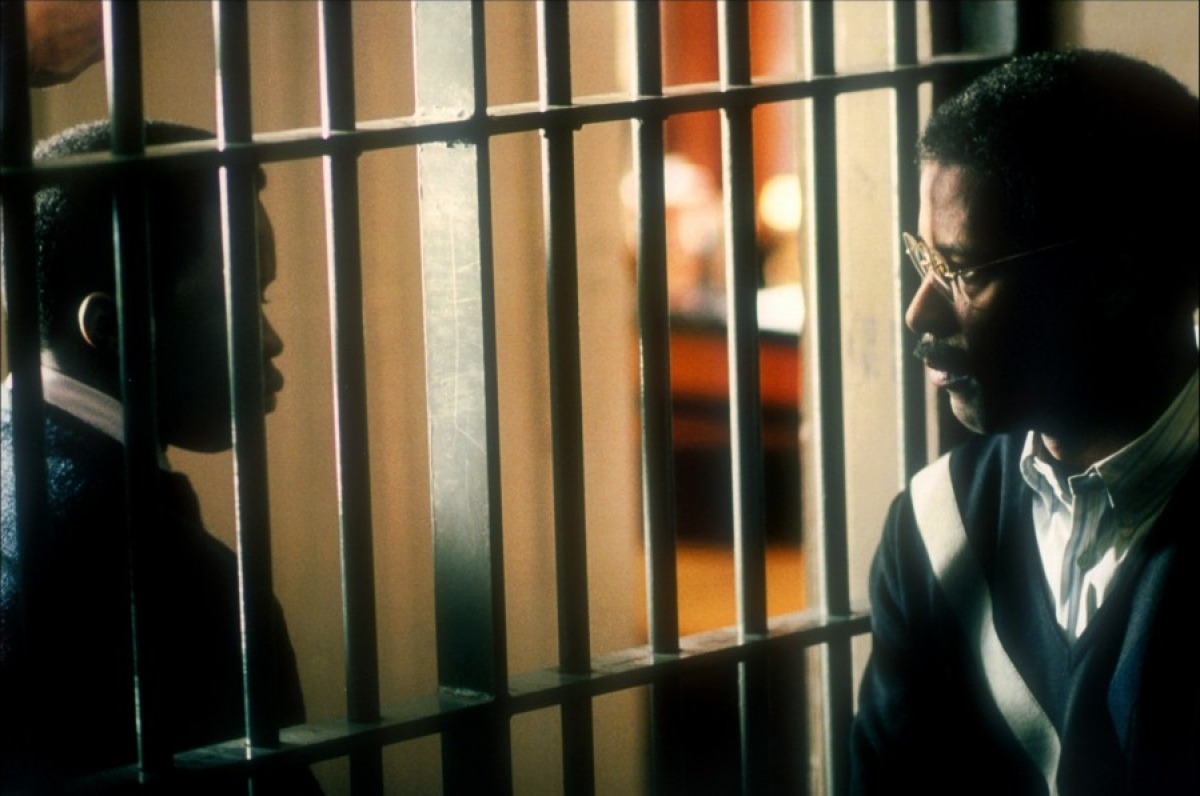
hurricane-carter-1999-03-gRemember the 1999 movie, The Hurricane? It’s the story of Rubin ‘Hurricane’ Carter, a champion boxer wrongly convicted for a triple homicide (Bob Dylan also drew attention to the story)

In the movie, there’s a scene where a teenage boy, Lesra, is told ‘sometimes we don’t pick the books we read, they pick us’.
I think there’s a truth to that. Sometimes, ‘our antenna’ on a subject is raised and we seem to be more receptive of stories on a certain topic or issue.

And that brings me to two different pieces of communication that found their way into my day.
The first was a story about R/GA:

R/GA And Techstars Launch A New Accelerator For Startups Devoted To Connected Devices

Then, a couple of hours later, this video from Cannes:

I’ll let you make the connection.

DUSTIN LANE
Brand Strategy | Advertising Concepts | Copywriting

Visit risinggiants.co or dustinlanecreative.com
How many ideas to present?

ideasbook-t1-460x460Most agencies usually take the approach of presenting three different ideas in response to a client’s brief. Actually, in many cases we’re contractually obligated to do just that.
The approach of presenting three ideas has both positive and negative points. First, some positives:

  • By presenting three ideas, you’re making sure you explore a range of solutions in order to find the right one for the job. Even though we try and explore as many ideas as possible, the fact that we have to put three different ones on the table can provide extra incentive. And we all know, that for every idea presented, there are usually numerous ones that didn’t make the cut for one reason or another.
  • Having three ideas also gives you a nice way of showing the client the journey of where your thinking took you – and they like to be taken on that journey. In fact, there are many theories around the ‘rule of three‘.
  • Inherently, people love having a choice. If you provide only one solution to a client, they can feel like they’re painted into a corner.
  • Having three ideas can also allow you to convince the client to do something a little more daring or unexpected. By presenting a third ‘they’ll never buy that’ option, you’re broadening the client’s horizons. Sure, they probably won’t be as daring to buy that third option, but it will help them perceive the next one below it as ‘less risky’.

And now some negatives:

  • Sometimes you come to a great idea, but rather than spending all the time on it making it as brilliant as it can be, you end up wasting time on other ideas that will only serve as cannon fodder in a client presentation.
  • You consistently waste two thirds of your work. Ultimately, you want all three ideas to be the absolute best they can be because you never know which one the client will choose. But the two ideas not chosen rarely see the light of day ever again. Even if the exact same brief arrives on your desk the next year, the client rarely accepts an idea they’ve previously seen (even if they really liked it the first time they saw it). In their mind, they often perceive them as old or unoriginal (even though they’re the only person who has seen them).
  • I know of pitches lost because the client has been given too much choice. They’ve been presented with a myriad of ideas (to help illustrate  the capabilities and breadth of thinking that the agency offers). However, it has backfired when the client perceives it as indecision and a lack of conviction for a single idea.

So, how many do you present?

DUSTIN LANE
Brand Strategy | Advertising Concepts | Copywriting

Visit risinggiants.co or dustinlanecreative.com

Image: courtesy of Poketo, where you can buy these books (but the ideas aren’t included)

Art Directors and Copywriters. What’s the difference?

I Love Copy ChangesAt every agency I’ve ever worked, there has been the ‘client walk around’. It’s where existing clients or potential clients are taken on a tour of the agency. There’s always a fairly similar response after you hear the ‘tour guide’ announce, ‘…and this is the creative department.’
It’s at this moment, you can look up to see a group of visitors eagerly looking on, as if anticipating some sort of magical and secret activity to give birth to ideas. Sometimes at these client orientation days, you’re invited to give a small talk and some Q&A about what your job is and how it contributes to delivering the product/service the client is ultimately paying for.
Usually, this means talking about the team structure and, traditionally, how art directors look after the pictures and how copywriters look after the words.

As we all know, the line between the roles is a little more blurred these days. Sometimes it’s removed altogether. So are there other differences between art directors and copywriters? Some people might say there are common traits that can be attributed to each title (keeping in mind there are always exceptions when making sweeping generalisations).

Of course, there’s the old joke:
Q: How many art directors does it take to change a light bulb?
A: I don’t know. What do you think?
Q: How many copywriters does it take to change a lightbulb?
A: I’m not changing a fucking thing!

If you’ve ever spent any time working with art directors and copywriters, you understand this joke. There’s a truth in the art director being more open to other opinions and less committed to making a decision by themselves. It also highlights that copywriters can sometimes be a little precious about changes to their copy.

My old art director and I used to discuss why this was so. We arrived at a few theories.
An art director’s career path is often via the studio where their job involves making lots of changes under other people’s direction. They’re used to having people sit on their shoulder, telling them to move stuff 2 pixels to the left and to adjust the cyan and opacity.
Also, the art director actually gets to make the changes to their work. Most clients can’t use InDesign or Photoshop (although this won’t be the case in the future) so their changes come back as suggestions or requests to be carried out by the art director.
On the other hand, everyone knows how to type. In Australia, english is a mandatory subject until you graduate from high school. This means clients have the option of typing straight over the top of the copywriter’s work, or firing up their preferred tool of choice – Track changes. So, often, clients don’t ask copywriters to change their work, they simply do it for them.
And sometimes clients have no real reason for making the changes they make – they simply think it’s part of their job description. For example, I can remember a radio recording once, where we had the radio ad just the way we wanted it (except final sound mix) when the client arrived for a listen and approval. The talent was still in the studio booth. Within a few moments, the client was making changes – ‘Can we just punch this word out a bit more?’, ‘Can we just say that word louder?’. I asked them, in a nice way, if we were making changes to fix something or if we were  making changes for the sake of making changes. They realised what they were doing, stopped and said, ‘Sorry, you’re right. I just started doing that automatically’.
And that’s the point I’m making. The creative team has thought about it and have a reason for doing it the way they’ve done it, so if the client is going to change it, they should have a reason too.
If the client doesn’t have one, it tends to make copywriters just a little  more bitter and twisted.

At one of my old agencies the question was asked why more creative directors come from a copywriter background rather than an art direction background (although that may not be the case these days – it seems pretty even). The reason someone gave was that copywriters spend years structuring an argument on selling a particular point of view via their copy, so this helps them in the role of CD. I’m not sure how accurate that is.
Another former boss thought that, generally speaking, art directors made better CDs because of their temperament.

What about you? Do you think there are any defining traits between art directors and copywriters?

DUSTIN LANE
Brand Strategy | Advertising Concepts | Copywriting

Visit risinggiants.co or dustinlanecreative.com

Are you fixing a problem or fixing a solution?

fixing_myself-1280x1024Many years ago, I was sitting in a university  theatre awaiting my first marketing lecture. In walked the lecturer and, for the next 40 minutes or so, he spoke to us about the fundamentals of marketing and the marketing mix.
One thing he spent a liberal amount of time on was the manufacturer model versus the consumer model.
He explained how the former was all about people making products firstly, and then selling them to consumers secondly (i.e. Henry Ford’s “Any customer can have a car painted any color that he wants, so long as it is black”). On the other hand, the consumer model was all about listening to what the consumer wanted or spotting a need for something, and then creating a solution accordingly.
The lecturer than explained that the Henry Ford approach was old and that the new way was the consumer model.
Well, some days I’ve sat at my desk and felt like I’m still waiting for those words to ring true.
I say this because I’m firmly of the belief that we should be spending our time coming up with solutions to help propel businesses and organisations forward. Yet in reality, a huge amount of time and effort is spent  making someone else’s ‘solution’ actually work.
I’ve lost count of the times I’ve looked at a brief and thought ‘Someone, somewhere, has decided that the requested solution answers a business problem. But how?’
Take the brief for an online banner ad. How many times have you actually clicked on one? I recently read that, statistically, you have more chance of surviving a plane crash. So why do we persist with trying to make them work? Sure, for some particular products or relevant placements, they do. But for the most part, they don’t. Aren’t we better off focusing our efforts elsewhere?
I’m not singling out online banners. The problem exists whether it’s traditional TV, press, outdoor, whatever. Put simply, sometimes ‘the solution’ isn’t a solution at all – it just becomes another part of the problem (i.e. how do I solve the real business problem using the ill-fitting solution that has been pre-determined?)
Sometimes this problem comes about by a mixed agenda within the client organisation. For example, I’ve seen the ‘product people’ do a side deal or partnership arrangement with another organisation and then throw a hospital pass to their marketing team with a ‘make this work’.
Over the years, I’ve even been asked to provide a post-rationalisation of why the solution they’re briefing me on to fulfill is the way to go.

Imagine how much better the solutions could be if you focused all  your time and effort finding the right one, rather than trying to make the wrong one work. That’s where the best work always comes from.

Maybe next time you take a brief that’s requesting a pre-determined solution, you could ask this:
‘Before I touch it, can you tell me why this TV/outdoor/print/banner ad/sponsorship/promotion/web page/app etc will be the right solution?’

DUSTIN LANE
Brand Strategy | Advertising Concepts | Copywriting

Visit risinggiants.co or dustinlanecreative.com

8 things ad agencies should do better

elephantA lot of talking happens around the subject of what the ad agency of tomorrow will look like and how it will operate. Changing business models, revenue structures and processes can seem like a big job, and it is. However, there are lots of relatively simple things a traditional ad agency can do right now to help improve the way they function:

1. Never under-estimate traffic
Good traffic people are the unsung heroes of the agency world. They are the true heart of an agency. Traffic is the junction where the creativity of an agency and the commercial  realities of running a  business meet. A good traffic person understands the creative process, and how hard it is to be confronted with a blank piece of paper or computer screen and turn it into a business solution. They realise the work required. They know if a job has been scoped correctly. They know the value of where time should be spent, and where it can be saved. They know the strengths and weaknesses of the teams and resources at their disposal. They’re a shoulder to cry on. They’re an ear for a whinge. They’re a guiding voice. They’re an island of reality in a sea of bullshit.
On the other hand, bad traffic people see their role as simply looking at a spreadsheet of jobs going through the agency and then blindly applying resource to them. Some agencies have even removed the role of traffic, simply adding it to a junior account handler’s duties.
Honestly, I reckon if you get traffic wrong, then you’re pushing it uphill from the start.

2. Be more personable
This is an issue also faced on a societal level. As we grow from a smaller, village way of living to larger communities, we become more impersonal. We start to lack empathy.
You see it in agencies too. When it happens, colleagues and fellow workers simply become faces in the hall. We no longer see them as team mates who have your  back and you have theirs. Sometimes, we  don’t even see them as people – people with feelings and families and other stuff going on in their lives.
In a former career, an older colleague once told me, ‘Your staff are your #1 customer’. Treat them accordingly.

3. Keep people informed
This pretty much follows on from the point above.
There is nothing worse than when you find out something about your agency in the trade press. It’s a bit like a stranger giving you news about your own family. A good agency believes in transparency. You’re never going to create a strong team if staff feel as though they’re not really part of it.

4. Manage the hierarchy
I’m not suggesting that ad agencies become communes. I’m a firm believer in fewer committees. Without hierarchy, things can easily turn to anarchy and an agency starts to look like William Golding’s Lord of the Flies.
However, you should avoid creating an ‘us and them’ culture. You don’t want to end up with an organisation consisting of the ‘haves’ and the ‘have nots’.

5. Know where the runs are coming from
It might seem obvious, but I’ve seen plenty of agencies that seem to have no idea which parts of their agency are successful. It’s usually a problem that relates back to point #2, above.
You should know which clients are doing what. Know which staff are doing what. Know the hours they are really working. Know which accounts are paying their way, and which ones aren’t.
Reward and resource accordingly.

6. Ask your freelancers
When you’ve had a senior freelancer in your agency for longer than 2 or 3 weeks, exit interview them. Freelancers are in the unique position of seeing ‘behind the curtain’ of lots of different agencies, allowing them a broader view. They know what works well and what doesn’t. They’ll give you a totally unbiased opinion of your agency, and their experiences in it.

7. Don’t be a slave to process
Never blindly follow process. Always remember that it’s there to facilitate and aid the end product rather than dictate it. I’ve seen agencies reduce the timeline on projects by up to 30% simply to accommodate their process. When this happens you have to ask, ‘Are we really focused on the end goal?’

8. Rethink awards
Awards have their place. When used well, they can give recognition to an agency, install pride, and attract new business and  talent.
However, when used badly they become a self-serving indulgence.
I’d invite agencies to challenge this. Is there a better way to use those considerable award show budgets? Could you redirect those funds into other avenues? Perhaps re-invent it as your ‘R&D budget’ to be used on building the agency’s own products. You have considerable resource at your disposal. Instead of paying your people to write case studies and craft entry boards, you could pay people to create films and art. Or build apps and business ideas you can white-label and then share the rewards with staff.

DUSTIN LANE
Brand Strategy | Advertising Concepts | Copywriting

Visit risinggiants.co or dustinlanecreative.com
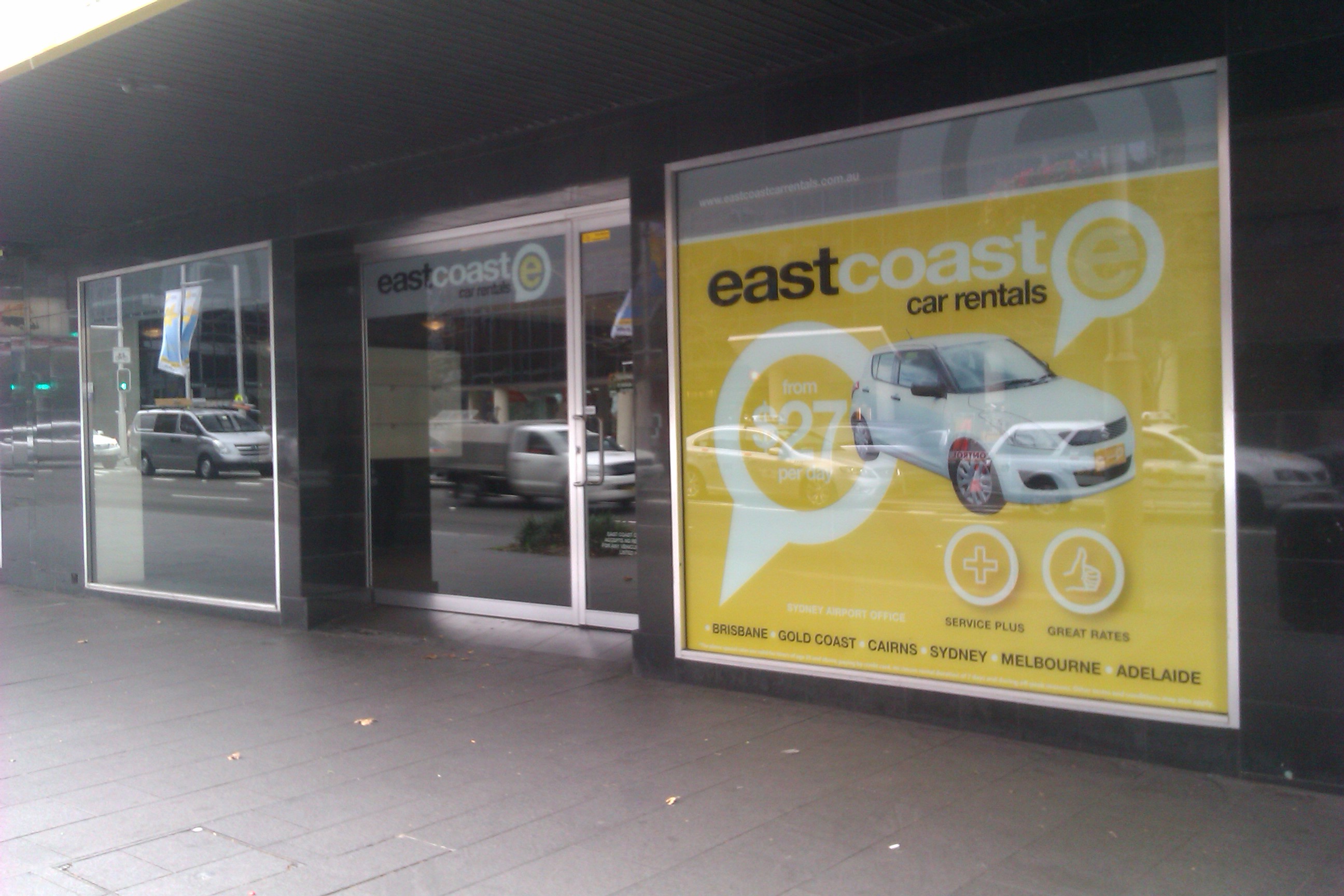
Photo: artwork by Banksy

John Cleese on Creativity

If you have 36 spare minutes, this is a good way to spend them…